


by MANPREET KAUR SINGH
If you want to teach children their language and culture, traditional
wisdom says, "Catch �em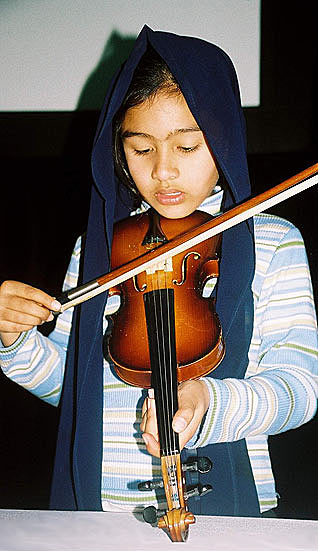
young". And that is what Sikh-Australians are doing by
sending their children to Punjabi classes, annual youth camps and
organizing regular cultural shows.
But the Sikh Kirtan Parchar Mission Australia (the
"Mission"), which believes that religious education plays a
vital role in a child’s personality development, is encouraging children
to take the next step – learn how to do kirtan in
their prescribed ragas and by mastering a traditional musical
instrument like tabla, harmonium, violin or sitar.
The Mission believes that when children perform at the gurudwara or
at other multicultural events, their self-confidence increases by leaps
and bounds, they acquire leadership skills which prepares them for a
better future and, in the bargain, they learn a whole lot about their
religion, traditions and culture.
Judging by the response to this year’s 5th Annual Gurbani
Singing Competition, parents and participants agree wholeheartedly with
the Mission’s approach.
Organized in Sydney recently at the Parklea gurudwara, in association
with the Australian Sikh Association, scores of children took to the
stage during the competition, singing kirtan both alone and in groups.
They also played a variety of musical instruments solo as well as in jugalbandi
("concert").
Says Kulbir Singh Malhotra, one of the organizers from the Mission:
"This year we had a record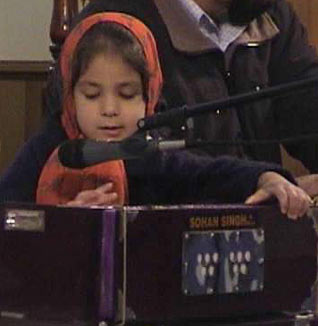
number of participants, 133 for Kirtan competition and 29 for the Quiz
competition. Apart from Sydney, youth from Melbourne, Canberra, Perth,
Newcastle and even Amritsar participated."
Held over two days, the competition adjudged participants on
"solo singing", "group singing", "Gurudwara
etiquette", "fluency in Punjabi & clear
pronunciation" and "organisational management".
"The youngest participant was 18 months old, who sat on the
stage and just said �satnam waheguru‘," recollects
Kulbir Singh. "But the most memorable moment for me was to see this
little child trying to play the harmonium even though he had to stretch
to the fullest, just to reach the other end of the instrument".
Although there were seven entrants under the age of 5, the primary
participation came from young teenagers aged between 12 and 17.
Amarjit Singh Chawla, the driving force behind this competition,
explains: "Our principal aim is to recognize children for
participating in an event like this. Irrespective of the quality
of their performance, we want to encourage them to stay involved and
keep on learning".
The grandson of the renowned educationist Bhai Hira Singh Ragi, in
whose name many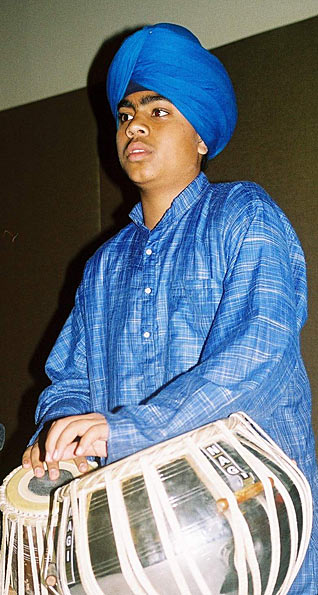
scholarships are awarded in India, Amarjit Singh came to Australia in
1989. "I was heartened to hear some children sing kirtan at the
gurudwara and felt we must do something to encourage them further."
With the help of sevadars, Gianis and parents,
children started learning kirtan formally and in 2001, the first Kirtan
singing competition was held. "Children participate readily",
says Amarjit Singh, "if they are having fun whilst learning. We
have also started cash awards as an added incentive".
Adds Kulbir Singh: "We realized that this was also important for
the self-esteem and personality development of children, so we added the
public speaking component to it. Children now talk at the open
forum, write essays, read poetry, participate in declamations,
etc. Although we encourage them to speak in Punjabi, we certainly
don’t exclude them if they want to use English as the medium.
Certainly, they get bonus marks if they speak in Punjabi, and that’s
another incentive to try and learn their mother-tongue".
18-year-old Jasmeen Kaur won this year’s Sikh Link trophy and was
adjudged winner of the Sikh Youth Leadership Award 2006 (Music &
Culture) for best female performance for the third year in a row.
"Its really great to be recognised this way. I think it’s
an honour not just for me, but the community that I come from",
says Jasmeen. She started singing kirtan from the tender age of six and
admits that, by the age of eight or nine, she didn’t want to continue
anymore because she felt she wasn’t good at it.
"But my mother encouraged me to continue and I’m so glad she
did. Performing kirtan in front of the sangat has given
me so much self-confidence, I feel I can handle challenging situations
quite easily. Also, my interpersonal skills have developed
manifold as a result." Jasmeen is now studying Commerce Law
in Macquarie University, Sydney.
12-year-old Gursagar Singh and 15-year-old Gurkeerat Singh Bulla were
chosen joint winners of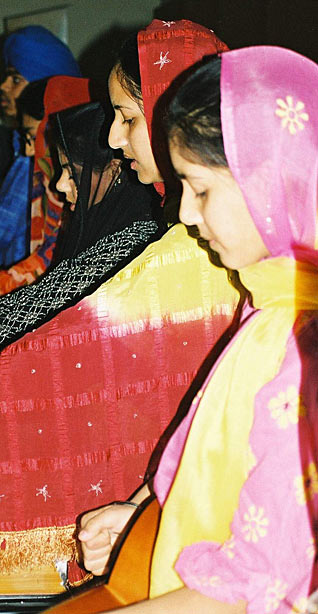
the Sikh Youth Leadership Award 2006 (Music & Culture) for best male
performance.
Padamdeep Singh, Gursagar’s proud father, declares: "We wanted
our children to associate closely with Guru Granth Sahib, to learn Sikh
values and become better individuals. I feel kirtan is the primary
medium through which children can understand the message embodied
therein, and they also learn ragas and Sikh classical music
along the way."
Gursagar, who is also a keen basketball player at school, adds:
"I’ve been learning to play the tabla for quite a few
years now and gave a solo performance at the competition. I feel
really happy when I learn new shabads and when the meaning is
explained to me. I feel like I have learnt something really
special."
Whilst in most cases, children are initially nudged by their parents
to take classes at the gurudwara, Gurkeerat Singh Bulla’s case was
unusual.
His mother, Sarabjit Kaur, explains: "We never pushed him much
to learn music or kirtan. Its through his own love and devotion
that he has learnt it so well. And ultimately, this only works if
the child is motivated from within; it can’t be sustained, if the love
and devotion doesn’t come from within the child himself or
herself. Like they say, you can only take the horse to the water
but you can’t make it drink."
Sarabjit recalls: "Even as a little child, Gurkeerat’s hands
would never stop drumming on the dashboard of the car while we were
driving, or on the table at home. When he joined the tabla
classes at the gurdwara, Giani-ji said he learnt in three
months what other children would take three years to learn".
"He feels at home at the gurdwara," she adds. "While
other children are usually playing outside, he doesn’t mind sitting on
the stage and playing the tabla continuously for three or four
hours. The funny thing is, he’s normally very fidgety and just
can’t sit still. But he is a completely different person at the
gurdwara".
So, is it hard for school-going children to manage school,
extra-curricular activities and gurudwara classes at the same time?
According to soft-spoken Gurkeerat,"I disagree with those people
who say they don’t have time to go to gurdwara because they have
homework or studies. You can easily finish studies at school and,
if necessary, at home. In fact, doing seva in the
gurdwara and learning over there is as important as school
work." He adds," I started out as a tabla
player and then people encouraged me to sing as well. In the last
four competitions, I played the tabla only, but this year, for
the first time, I sang as well. I feel really good when I sing
kirtan: it’s like something deep inside me feels really calm and
peaceful".
So, what is the real value of a �kirtan competition’?
22-year-old Japneet Kaur Bindra, has been involved with the Mission
competition since its very inception: for the first four years, as a
participant, and this year as a coordinator.
According to her, "This event should not be seen as a
competition. Rather, it is a learning process. It is a time when
children of all ages and from all over Australia come together and sing
the words of the Gurus. The children learn about Gurbani, ragas,
kirtan, and the traditional way in which they should be performed."
Furthermore, Japneet says, "In this competition, no one is a
loser. In fact, everyone is a winner because everyone has something to
gain. True, there are awards, prizes and trophies, but this is just a
formality and more of an encouragement for the children who spend months
tirelessly preparing for the competition. This programme provides a
platform for the children to demonstrate their growing talent and
potential. It teaches them about self-confidence and self-esteem."
Adds her sister, Luvneet Kaur Bindra, also a finalist for the Sikh
Youth Leadership Award 2006: "We are the new Sikh generation of
today. It’s we who will carry on our tradition, culture and
religion into the next generation. An event such as this is important in
bringing us back to our roots and reminding us about the essence of
Sikhism."
Which perhaps echoes the importance of kirtan as enshrined in the
Guru Granth Sahib, which states: kaljug mein kirtan pardhana ("in
this dark age, kirtan is of prime importance").
So, whether you do it for religious reasons or for personality
development, kirtan seems to be the panacea for the body, mind and soul.
133 Australian Punjabi youngsters were living testimony to this recently
in Sydney and will hopefully provide inspiration to many more in the
coming years.