


by MANPREET KAUR SINGH
Australia, a country built by migrants, is a natural when it
comes to support and promotion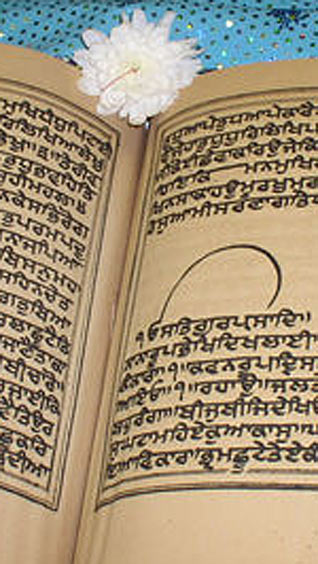
of multiculturalism. Like many other communities, the
Australian Punjabi community has reaped rich benefits of this policy, as
a result of which language schools, community centres and cultural
organisations have flourished over the past few years.
In fact, a brand new Sikh Community Centre is currently being
purpose-built in Melbourne to fulfill the growing needs of the Punjabi
community. The million-dollar project, proposed by the Victorian
Sikh Association, is being partly funded by the local government and the
Council has provided a grant of $480,000 for its development.
But the biggest impetus to the promotion of Punjabi culture came when
the Victorian government formally recognised Punjabi as an accredited
language for the school curriculum. This meant that for the first
time anywhere in Australia, students in Melbourne and other Victorian
areas could study Punjabi as a school subject, and get additional
credits for it at the end of Year 12 (called Victorian Certificate of
Education or VCE).
As a result of this, 22 Victorian students took the Year 12 VCE
Punjabi exam at the conclusion of the first term, and two young women
from Melbourne scored the highest marks in the entire state.
Chandan Preet Kaur Passi and Sital Kaur Gill, the two top scorers
from Victoria, were ecstatic at this achievement. "I’ve been
learning Punjabi ever since I was a little girl and now it has helped me
secure a place in one of the most prestigious universities of
Australia", says Chandan.
She is currently studying at the Royal Melbourne Institute of
Technology ("RMIT"), one of the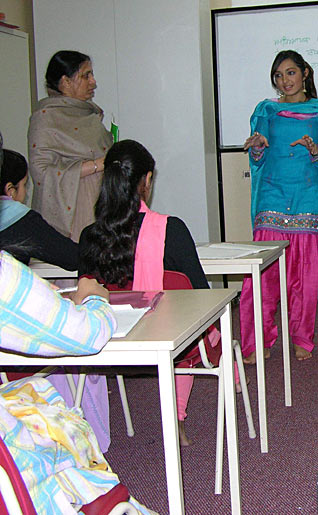
elite institutions of Australia, and she believes that the extra credits
she received for studying Punjabi helped her get the prized admission.
According to the education system in Victoria, every student studies
five subjects in Year 12 and the highest marks obtained in four subjects
are added to obtain the ENTER score. The ENTER score determines
which University you go to or which course you get admission in.
But the score for languages other than English, like Punjabi, get
additional weightage, as a result of which even getting 40 out 50 in the
subject gives the student an excellent ENTER score.
The situation for the other topper, Sital, is even better. "I
took the exam when I was in year 11. Now I’m in Year 12 and can
concentrate harder on all the other subjects because I’ve already got a
great score in Punjabi. I’m so proud because on the one hand I have
learnt my mother tongue really well and on the other, it’s given me
better prospects for further education and higher studies".
Sital first learnt Punjabi in Singapore, a country where she spent
most of her school years and only came to Melbourne last year. She
attributes her success to the firm grounding she received in that
country.
"In Singapore, it is compulsory to choose a second language at
school and one has to choose between the local language and
Punjabi. It was an obvious choice for me, because even though my
family migrated from India generations ago, they have kept the culture
alive. Everyone spoke Punjabi at home and it was only natural that
I learnt it at school", says Sital.
Chandan’s family, on the other hand, migrated to Australia ten years
ago and she has done almost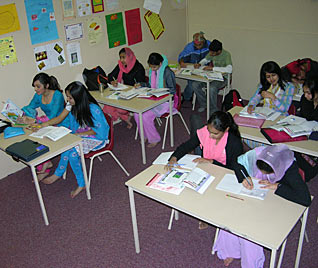
all of her schooling in Melbourne. But right from the beginning,
she spoke Punjabi at home and attended the Punjabi classes at the local
Gurudwara.
"My parents always encouraged me to learn more about the Punjabi
language and culture. Being religious-minded, we went to the gurdwara
regularly, and that’s where I formally learnt the language.
Initially, I just wanted to be able to talk to my relatives in India and
write letters to my grandparents. Now I can read Punjabi
literature, history, novels and I can even do paath, something
I’m really proud of."
Traditionally, Punjabi classes have been held over weekends at the
local gurdwaras so that children can attend the classes while
the parents listen to shabad-kirtan. Even now, although
Punjabi has been accredited as a VCE subject, classes are still held at
the gurudwara school or at other centres opened by Victorian School of
Languages ("VSL").
Parents still have to make the extra effort to drive their children
to the class venues every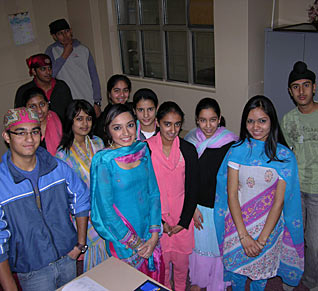
weekend. But until last year, parents only had emotional reasons to
teach their children Punjabi; but with the Victorian government’s new
initiative of including Punjabi in the school curriculum, parents now
have a more tangible reason for teaching Punjabi – children
could have a better future, and a better prospect of getting admission
in coveted universities.
Dilpreet Jaswal, Principal of Khalsa Punjabi School since 1999,
explains: "Children can only learn Punjabi if their parents
take the initiative. We teach the children once a week, but
parents have to make sure they speak Punjabi at home, finish their
homework, bring them to school regularly, etc."
Opened in 1995, Khalsa Punjabi School is one of the largest Punjabi
schools running in Victoria, with 90 children enrolled at various levels
this year. Fully funded by Communities Languages Australia, it
operates within one of the larger gurdwaras in Melbourne.
According to the Principal, "Children don’t just learn the Punjabi
language at our school. We also teach them about our culture and
our values, we discuss current affairs and encourage them to participate
in shabad-kirtan as well. If you ask me, these kids are
much better Punjabis than the children growing up in Punjab today.
In India, its not very fashionable to learn Punjabi, most children speak
Hindi because even the parents speak to them in Hindi. And with
the increasing influence of Bollywood and western culture on TV, not
many Punjabi children in India know about our history, our culture or
our religious heritage. I know it’s important to expand your
horizon, but it shouldn’t come at the cost of forgetting your own
traditions. I think I can safely say that our kids here are far better
off in this respect than those in present-day Punjab."
Apart from the Khalsa Punjabi School, VSL runs five Punjabi centres
across Victoria. Fully funded by the state government, hundreds of
children are enrolled for these Punjabi classes as well.
Frank Merlino, the Principal of VSL, declares: "Many studies
have proven that knowledge of a second language helps to improve a
student’s literacy in English. That’s why we encourage learning of
a second language and run classes in 44 languages around
Victoria".
Established in 1935, VSL runs classes in many subcontinental
languages apart from Punjabi, such as Bengali, Hindi, Sinhala, Tamil and
Urdu. But, Merlino warns, "It is essential that the Punjabi
community takes full advantage of the recent VCE accreditation and
encourages students to study it at all levels. If this doesn’t
happen, then the VCE accreditation could be lost, as it happened with
Bengali last year. Student enrolments for the VCE Bengali exam
fell below the critical number of 15 for three consecutive years, and
its accreditation was scrapped last year".
But Merlino is upbeat about the future of the Punjabi classes in
Australia. "Given that Australia is increasing its trade
arrangements with South Asian countries and given that we have a
significant Punjabi community in Victoria, I feel Punjabi classes have a
bright future here. While some parents might give English studies
a priority at the expense of the background language, I think the
Punjabi community by and large encourages its children to study
Punjabi."
And what do the successful Punjabi toppers of Victoria have to say
about this? According to Sital, "Punjabi is our maa-boli,
our mother-tongue. If we don’t learn it, who will? If you don’t
know Gurmukhi, you can’t do paath, and wouldn’t that be
awful?"
Adds Chandan, "If we don’t know about our own history and
culture, how can we ever explain it to others? I think once you
learn Punjabi, you create your own identity and learn something for a
lifetime. I wish all mums and dads would give this gift to their
children, so they could reap the benefits in the future".
Currently, there are 21 students enrolled in Year 12, who will take
the VCE Punjabi exam later this year. Hopefully, all the attention
Chandan and Sital have received will encourage more parents to send
their children to Punjabi classes. It would be wonderful if the
Victorian example will be followed by all other states of
Australia, with Punjabi receiving its rightful recognition in
schools across the country.
Just like no tree can grow tall without deepening its roots first, no
community can progress without a firm grounding in its culture, and no
migrant can embrace a solid future without upholding the past
traditions.
Here’s to learning oorha .. airha .. eerhie .. sassa
alongside A-B-C-D, for many generations to come.