


by MANPREET KAUR SINGH
Melbourne, Australia
I don’t think I cry easily … not in a way that the tears flow
unabated at least, and when two hands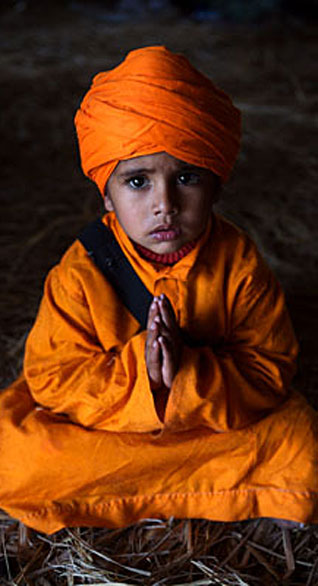
are too few to wipe the spontaneous outpouring.
But it happened unexpectedly last weekend, when my teenage nephew had
his dastaar bandhi ceremony, a day he chose to partake in the
long-respected Sikh tradition of tying a turban for the first time, of
affirming his resolve to continue doing what his father and grandfather
and many generations before them had done, as a symbol of their Sikh
identity.
But what was it about the simple ceremony that had overwhelmed not
just me, but many others present on the occasion?
True, the paatth recitation had been meaningful and the kirtan
was soul-stirring, but that was normal – that’s how paatth
and kirtan make you feel every single time. But soon
after the ardas that day, having asked for the Almighty’s
blessings and approval for the ceremony, family members brought out a
maroon turban, and tied it around the young man, sitting gracefully in
front of the Guru Granth Sahib.
Layer after layer, the turban was wrapped, and eyeful after eyeful,
the tears flowed.
What was it about the puggri that made us all so emotional?
Was it the fact that this young man, born and brought up in
Australia, had publicly affirmed a tradition that began centuries ago in
a different continent?
Was it a coming-of-age for him, and an acceptance of the burden of
adulthood?
Was it his public proclamation that from this day on, he chose
to be a Sikh, over and above being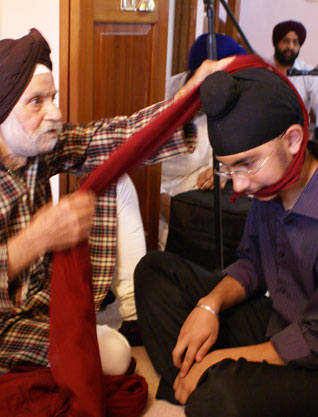
born as a Sikh?
Or was it that these five metres of plain voile cloth symbolized a
proud history, and by reasserting its significance in the 21st
century in far-off Australia, it reaffirmed our unique collective
identity?
Perhaps the answer is all of the above, and much more.
For me, it was also a deeply personal reminder of the circle of life
in synchronized motion – the infant who was only two months
old when I became a part of my new family, was now old enough to hold
the torch passed down to him and ready to lead the way!
Generations ago, sons and daughters just adopted family traditions
without pausing to question them. Customs, traditions and
concepts, preserved as family heirlooms, were transferred down many
generations without much dilution or alteration.
But the modern times are different. Today’s child needs to
question everything – and needs a logical answer to
everything, too. You can’t give emotional reasons when they ask
"Why do we wear a patka?" or "Why does Dad wear
a puggri?"
Decades ago, if a child dared to question anything, the doubt quickly
evaporated when a family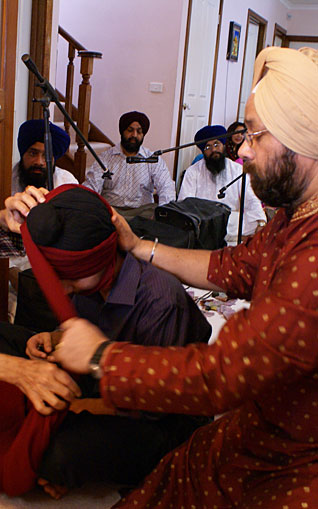
elder simply said: "Because that’s how it is!" or
"Because I said so!"
Today’s children do not acquiesce that easily. They want to
know why this tradition is relevant in the modern context. That’s
why, as a mother of two boys aged ten and six (also born and living in
Australia) who proudly sport a patka at all times, I frequently
ask myself and others around me the same question, looking for a logical
answer to give my children if they ever asked me.
Another way to look at it is that if a child begins to question the
concept of patka or puggri persistently, it might
already be too late to stem the tide of doubt.
Perhaps the best way is to pre-emptively talk of logical reasons
along with the emotional ones, so the child not just accepts but
appreciates his unique identity.
Most of us usually begin by telling our little children that we keep
unshorn hair and cover it with a patka or puggri
"Because Guruji asked us to!"
When they grow older, I’ve heard a mother tell her son, "Because
it makes you an instant star – everybody at school
recognizes you and knows your name!"
My son confirms that when he tells me: "Even the substitute
teachers coming in for a day remember my name after reading it once,
even though they forget other people’s names in class".
Another mother told her son, "Because of your patka, I
can spot you from a long distance – I don’t think you can ever get
lost, because I’ll know your patka instantly, even from a mile
away".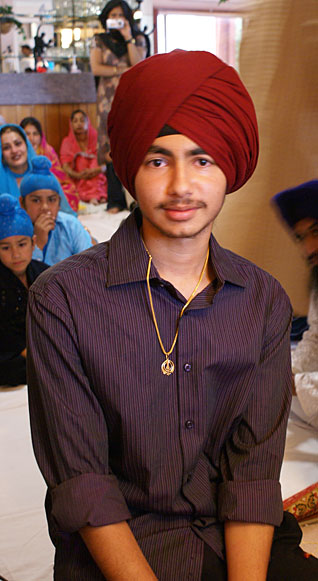
True, the boys are labelled "melon head" or "egg
head" at school, but if wasn’t that, it would be "shorty"
or "blackie" or "fatty" or some other epithet,
because kids will be kids, and will always find something to pick
on.
A major part of growing up is learning to stand up for yourself and
perhaps wearing a patka could even speed up that process.
In fact, a youngster born and brought up in England once told me,
"Since I wore a patka at school, I knew I was different and learnt
that I didn’t have to follow the others blindly in what they did.
So, during my adolescence, when a lot of my friends had peer pressure to
do drugs, drink alcohol and that stuff, I just knew I didn’t have
to follow them – I could get away with it, since I was
already different".
Now living in Australia, and a father of two himself, this youngster
gave me a wonderful logical reason to wear a patka/puggri in
the modern context!
Taking his logic further, wearing a patka is excellent
training for little children to dare to be different, to revel in their
uniqueness, to make others accept who they are and to celebrate their
identity.
Perhaps, apart from according a "uniform" to the Sikhs, the
unshorn hair and the covering it with a patka/puggri has a
deeper logic, too – it keeps the followers disciplined by
mandating an outward appearance that is non-negotiable. It extends
the logic to personal life, as well, that certain principles and
concepts enshrined in the faith are non-negotiable, too. It gives
youngsters the moral courage to dare to be different (and proudly so)
from an early age, and affords them an opportunity as young adults
to publicly proclaim that they are willing to take the tradition
forward, to accept its physical manifestation and its spiritual
one.
So, perhaps when my nephew had his dastaar bandhi last
weekend, I was deeply touched by all the symbolism it represented.
As I told him, it is perhaps the biggest gift a child can give his
family – of putting his hand up to carry on the family
tradition and trying to abide by all the spiritual significance it
entails.
Now, I look forward to not just my own two sons giving me a chance to
revel in my tears, but also the sons of many other parents around the
world, doing their best to keep this age-old tradition alive. I
hope and pray for my nephew and others like him, that after being born
as Sikhs, I hope they see the value in choosing
to be Sikh and then, through their actions,
prove to be the ultimate Sikhs.
Till then, I hope to keep the floodgates on my tears –
and save them for the moments of true, spontaneous joy!
April 3, 2008