Rajinder Singh – Physic s Teacher , Researcher and Historian of Science

Abstract
The history of science is a fascinating subject. Rajinder Singh has written biographies of some prominent but also of many lesser-known scientists of India, mostly of Calcutta School of Physics. He is considered as an authority on CV Raman whose life and work became the subject of his D.Sc. thesis in Germany. His monumental work includes how and why Mahatma Gandhi missed the Nobel Peace Prize. He also wrote about Indians who were nominated for Nobel Prize and some others who played the role of nominators. He is the first historian of science to cover a vast range of topics concerning Indian science and scientists.
Keywords: History of Science; CV Raman; Calcutta School; Biography; INSA
INTRODUCTION
My interest in history of Indian Science was aroused when I participated in a National Symposium cum Workshop organized under the auspices of National Commission on History of Science by Indian National Science Academy (INSA) at New Delhi in Sept. 1974. My Paper “Cosmology in Science and Religion” was published in the proceedings [1] . Dr DS Kothari, President of INSA and UGC Chairman, who chaired the session in which I presented my paper, encouraged me to elaborate the contents further. Consequently, I published my book “ Brahmand Di Rachna ” (Creation of Universe) in 1978. A decision was made at this National Symposium to introduce teaching of History of Science in Universities at B.Sc. level. Very few Universities implemented this recommendation of INSA. I believe, our University was one of those rare Universities to introduce this subject at M.Phil. level.
I was introduced to Rajinder Singh through his articles in Current Science, which was my favourite Indian journal started by CV Raman . His first paper “ Sir C.V. Raman and the story of the Nobel Prize ” appeared in Current Science during 1998 [2]. CV Raman was my role model but the story of his winning the Nobel Prize as narrated by Rajinder brought some new insights to my memory. I retired in June 2002 from Guru Nanak Dev University, Amritsar and planned to enter the arena of History & Philosophy of Science as a full-time engagement. However, my dream remained unfulfilled.
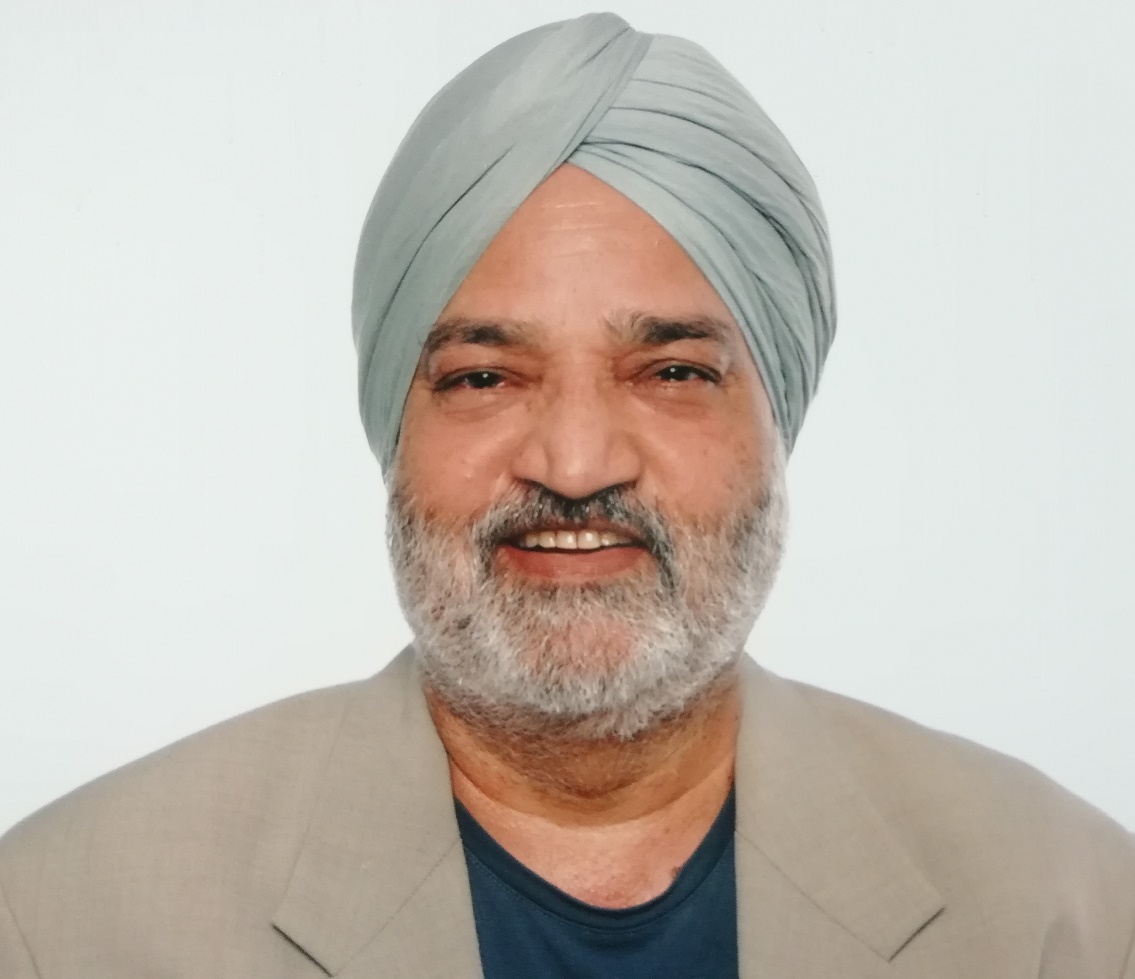
Rajinder had published nearly a dozen articles in Indian Journals by end of 2002. I had the privilege of reading his books and writing Reviews of nearly a dozen books, with my first review “ Inside Story of Nobel Peace Prize Award – Indian Contestants ” published in Current Science in 2016 [3] . His score of publications, including his 44 books and research papers, has crossed two centuries [4] .
EARLY LIFE AND EDUCATION IN INDIA
Rajinder was born on 5 October 1957 in village Lidhran in district Jalandhar of Indian Punjab. His maternal grandfather was a pious man with spiritual leanings who made a prediction, p rior to Rajinder's birth, that this child would carry on the legacy of Matharu family and bring recognition to it on a global scale. His mother believed in this prophecy and brought him up as a prodigious child. His family had no means to educate him in a convent school. So, he got his primary education in his village school at Lidhran . He consistently ranked among the top three students in his class. However, the school was not well-equipped; there were only three rooms for the five classes. Rajinder enrolled in the United Christian Boy's Higher Secondary School in Suranussi , near Jalandhar , as his parents wanted to educate him in an urban school for better higher education.
While studying in this Christian School, he was selected for a German scholarship program known as 'Kinder Not Hilfe ' (Help for Children in Emergency). This support covered his hostel accommodation, tuition fees, stationery, and provided even a small amount of pocket money. In practical terms, his parents did not need to bear the expenses for his school education. Despite not being a Christian, he was fortunate to receive this scholarship. This was due to the school's obligation to admit some non-Christian students in accordance with Indian Government policies.
When Rajinder was in the 8th grade, the Punjab Government conducted an examination to identify talented students from Punjab. The goal was to provide special training and scholarships to promising young Punjabis. This examination took place at the district level, and he was one of the fortunate individuals selected after the assessment. However, his Headmaster was reluctant to let him go. Rajinder topped in 10th grade and his name was displayed on the school Hono u r s Board for the year 1974.
After completing his Matriculation, he joined 'Pre-University' class at D.A.V. College, Jalandhar. His means were limited to financing his college education; hence he started giving tuition to students who could afford to pay him for coaching them Physics, Chemistry, and Mathematics. It was a taxing job to coach for four hours after finishing college around 5 pm. His routine was to return home usually by around 9.30 pm and continue with his own homework assigned by the professors. He passed his B.Sc. from DAV College but could not afford to join M.Sc. in some university due to financial constraints. Interestingly, his initial intention was never to become a teacher. However, fate had other plans for Rajinder. His former school Director advised him to join B.Ed. and assured him to cover his expenses, and provide him accommodation, in addition. He served in four High Schools around Jallandhar as a Science teacher before going to Germany for higher education and research .
RAJINDER SINGH: A STUDENT AND RESEARCHER IN GERMANY
Rajinder reached Germany in July 1985, after he was invited by a former German lady acquaintance who met him in India. She knew about his keen interest to study physics and motivated Rajinder to apply for permission to stay in Germany for the purpose of higher education. She was prepared to provide a guarantee to support him financially for five years. But the foreign office in Germany refused to grant him permission for a longer stay beyond what was stipulated by a simple tourist visa. With the help of his friend, Rajinder sought legal remedy and the matter went to court. While the legal process was going on, he enrolled in German language classes and applied for admission in both Physics and Computer Science programs. Surprisingly, he was accepted into both programs, even without a student visa. He joined ' Diplom Physik ' at the University of Oldenburg, a five-year degree program in the German education system, following an Indian B.Sc. degree.
He continued as a Diploma student while his case was pending in the court . He embarked on his journey of learning the German language and Physics, and eventually enrolled at Oldenburg university. He had no Scholarship and no regular job to pay his tuition fees. At the time, he resided 30 kilometers away from the city of Oldenburg, and due to financial constraints, he had to make the daily commute riding by bicycle. This proved to be a testing time for Rajinder, particularly during the winter months, when the snow made it difficult and risky, and during the rainy season, to cycle down the road. It was a rare feat to accomplish this daily routine. He survived by undertaking cleaning jobs in private homes or restaurants.
After securing his student visa of stay in Germany, he began applying for various scholarships, though success didn't come easily. Finally, his perseverance borne fruit and he won a scholarship from the "Bunt-Stift" Foundation, initially awarded for a six-month period but later extended for three years, which provided the necessary support to complete his Diplom-Physik . His Diploma Thesis centered on solar energy and meteorology. After completing this phase of his studies, he took parental leave to allow his wife to work as a school teacher . For four years, he did baby-sit ting to raise his two kids until they were old enough to attend Kindergarten school.
During his time as a stay-at-home parent, he kept alive his passion for physics. In the Department of Physics at Oldenburg University, there was a professor who had numerous projects related to the history of science. His specialization involved replicating historical experiments under authentic conditions, such as recreating CTR Wilson's experiments with a cloud chamber. Most of the group's work focused on European and American scientists. Rajinder approached the Professor with the idea of working on the Indian physicist, C.V. Raman, the pioneer of Raman spectroscopy. He agreed to supervise his thesis but explained that there was no available funding to offer him financial support. However, he was willing to provide recommendation letters if Rajinder applied for scholarships or grants.
After a four-year break in studies, Rajinder applied for a Ph.D. grant scholarship, but was not successful on the first attempt. After a year, he made a second attempt, and this time he was successful. Thanks to the Heinrich-Böll Foundation scholarship, he was able to pursue his Doctor of Science degree from the University of Hamburg, after registering as a candidate in the Department of Mathematics , with a special cell working on history of Mathematics and Science . He was initially discouraged from working on the beaten track of working on CV Raman and his research on scattering of light, but Rajinder was determined to carry on his propos ed topic . Ultimately, he won laurels by presenting his thesis on Nobel Laureate C.V. Raman’s work on Light Scattering. It is a unique contribution to the history of science.
RAJINDER SINGH: A SCIENCE TEACHER IN GERMANY
Rajinder undertook more than a dozen years of rigorous training to start his teaching career as a Science teacher in a High School. He is most likely the only Indian-born science teacher in Lower Saxony, if not in all of Germany. At his school, he introduced science competitions such as ' Jugend forscht – Schüler experimentieren ' (Young Researchers – Student Experiments). This science competition spans from the district level to the national level, and Rajinder has supervised over 50 projects. His students have achieved frequent success in these competitions, often receiving recognition in local newspapers for their achievements.
Several years ago, the European Union launched the 'Erasmus Project' to encourage schools to collaborate with neighboring countries. Teachers from various schools and countries come together to develop projects, such as those focused on 'Renewable Energy.' Each school commits to working on such a project for two years, with students and teachers visiting other countries every three months to present their findings. Rajinder guided two such projects, one involving seven countries (Setting a Seed for Change – Comenius, European Union Project, with schools from Germany, France, Italy, England, Spain, Lithuania, and Romania) and another involving eleven countries (Mission into the Future: A Quest for Sustainability – Comenius, European Union Project, with schools from Germany, France, Italy, England, Spain, Lithuania, Romania, Turkey, Portugal, and Holland) [5].
In 2005, he was selected by the Goethe Institute in Munich to represent Germany and deliver a lecture in Dhaka, Bangladesh. The program was organized in collaboration with the German and Swiss embassies and the Ministry of Science and Technology of Bangladesh. He is playing active role in environmental and social issues as a schoolteacher. Last year, he was part of a delegation from the city of Syke , where he works. Members of the Syke delegation and their partners from Bresien , Poland, visited their sister city, Al Hochima , Morocco. The primary aim of this initiative is to bring together young generations to facilitate the exchange of ideas on environmental and other political and social issues.
RAJINDER SINGH: A SUCCESSFUL HISTORIAN OF SCIENCE
The success story of Rajinder Singh is attributed to his contributions in the area of History of Science. He has devoted his life in writing Biographies and set a new tradition by writing on lesser-known scientists from India. His choice of studies has been scientists of Calcutta School, pioneered by CV Raman, the Indian Nobel Laureate. His journey starts from the University of Oldenburg, where he started research on the history of science in 1995. However, he registered himself as a Doctoral student at the University of Hamburg in 2003. Prof. Gudrun Wolf Schmidt (University of Hamburg) and Prof. Falk Riess (University of Oldenburg) were his thesis supervisors. He was awarded D. Sc. by Hamburg university on his thesis exploring the lifetime achievements of Sir CV Raman . His investigations exploded some myths created by his countrymen around the persona of Raman. I find Rajinder has a sharp intellect and incisive approach to sift grain from the chaff during his analysis of historical events.
Rajinder has established himself as a specialist on CV Raman. No one else has written so many books covering all aspects of C.V. Raman’s stay in Calcutta and Bangalore . The list of his books on history of science is approaching half a century with the following six on the legacy of CV Raman:
Nobel Laureate C.V. Raman’s Work on Light Scattering, Logos Publisher, Berlin 2004.
Nobel Laureate C.V. Raman’s Science, Philosophy and Religion,
Dharmaram Publications, Bangalore 2005.
C.V. Raman’s Laboratory and Discovery of the Raman Effect,
Shaker Verlag, Aachen 2018.
C.V. Raman and the Press: Science Reporting and Image Building – Part I: Kolkata Period, Shaker Publisher, Dueren 2019.
C.V. Raman and the Press: Science Reporting and Image Building-Part II: The Indian Institute of Science Period, Shaker Publisher, Dueren 2020.
C.V. Raman and the Press: Science Reporting and Image Building – Part III: The Raman Research Institute Period, Shaker Publisher, Dueren 2020 .
The Biographies of prominent Indian Scientists like JC Bose, CV Raman, HJ Bhabha, and PC Ray have been written and made part of Indian school curriculum but equally important men of science who excelled in their field of research have been neglected by the Indian print media. Rajinder took up cudgels to bring these scientists into limelight by writing their Biographies after digging up archival resources in India and Europe. He is the first historian of science who has published biographies of three prominent Indian Women Scientists: Bibha Chowdhury and Purnima Sinha of Calcutta University, and Suman Beri of Panjab University Chandigarh. The other Indian Scientists who have been brilliantly exposed to public view by Rajinder are DM Bose, SC Sirkar, NR Sen, K. Bannerjee, BB Ray, SR Khastgir , and SD Chatterjee. DM Bose and SD Chatterjee made some fundamental contributions to Physics in India and abroad. Most of his Biographies have been reviewed by me [6-11].
To the best of my knowledge, Rajinder Singh is the first historian who has written extensively on Indian Nobel Prize nominators and nominees. His research work on Nobel Prizes is based on the original documents obtained from the archives of Royal Swedish Academy of Sciences, Stockholm, and Nobel Peace Centre, Oslo, Norway. The following four books are listed under this classification :
Chemistry and Physics Nobel Prizes – India’s Contribution, Shaker Publisher, Aachen 2016.
Inside Story of Nobel Peace Prize Award – Indian Contestants , Shaker Publisher, Aachen 2016.
India’s Nobel Prize Nominators and Nominees – The Praxis of Nomination and Geographical Distribution, Shaker Publisher, Aachen 2016.
Die Nobel Preise und die indische Elite , Shaker Verlag, Aachen 2016.
Rajinder Singh is a prolific writer who has extensively written on Mahatma Gandhi’s life and Nobel Peace Prize. I think he is the only author who probed the intricacies of Indian politics and missing of Nobel Peace Prize by the most deserving Indian politician, whose legacy survives all over the globe but being relegated in his own country. The following four books are ample proof of Rajinder’s contribution to the legacy of Mahatma Gandhi:
The Making of the Politician M. Gandhi by Muslims, Jews and Christians – Gandhi’s Methods to Solve Immigration Problems , Shaker Publisher, Aachen 2015.
Mahatma Gandhi für Lehrkräfte und Eltern – ”Mahatma“– ein normaler Menschen wie du und ich , Shaker Verlag, Aachen 2016.
Mahatma Gandhi – der verpasste Friedensnobelpreis , Shaker Verlag, Aachen 2017.
Gandhi and the Nobel Peace Prize , Routledge Publisher, New York 2017.
A survey of Rajinder’ s books and articles amply elucidates that he had used the ‘original’ and authentic sources/ documents for his research in documenting the Biographies of Indian Scientists . He is known to have collected material from various archives in the USA, Germany, Holland, Denmark, Hungary, Canada , and India . He has been a frequent visitor to India for collecting research material from archives in Delhi, Kolkata, and Bangalore.
His publications run into two centuries. Indian scientific community is well versed with his publications in Indian J. History of Science , Current Science and Science and Culture . Consequently, he has been often invited to deliver lectures by various Indian institutions. At the occasion of commemoration of 75th year of independence of India ( Aazadi Ka Amrit Mahotsav ) , he was invited by the Indian National Science Academy ( INSA ) to deliver the first talk on ‘History of Science S eries ’ . At the birth anniversary of the great S.N. Bose, he was asked to deliver lecture at SN Bose National Centre for Basic Sciences (SNBNCBS), which was funded by DST of Govt. of India.
In 2018, he was part of the Indian team including well known Science Historian Prof. Deepak Kumar, Astrophysicist , and Prof. A.R. Chowdhuri of IISc, Bangalore to organize an International Conference of the History of Science , which was funded by the INSA. In cooperation with Prof. A. Kundu and Prof. G. Gangopadhyay, both University of Calcutta, Rajinder has written on the history of its famous Physics Department [12], which served as the nucleus of Calcutta School of Physics nurtured by the stalwarts like CV Raman, SN Bose, and MN Saha . Rajinder has collaborated with some eminent Scientists for writing Biographies of Indian Scientists, the most prominent among them is Prof. S.C. Roy, formerly of Bose Institute, Kolkata and Editor-in-Chief, Science and Culture .
Rajinder Singh enjoys the status of a house-hold name in Kolkata. He has been honoured with academic awards and felicitated by many universities, academic institutions, and National Academies of India by inviting him to deliver special lectures on history of science in India. It is unfortunate that he has yet to get accolades and recognition from his own people in Punjab. Prof. Arun Kumar Grover, ex-VC of Punjab University, Chandigarh, deserves our gratitude for promoting his work in Punjab.
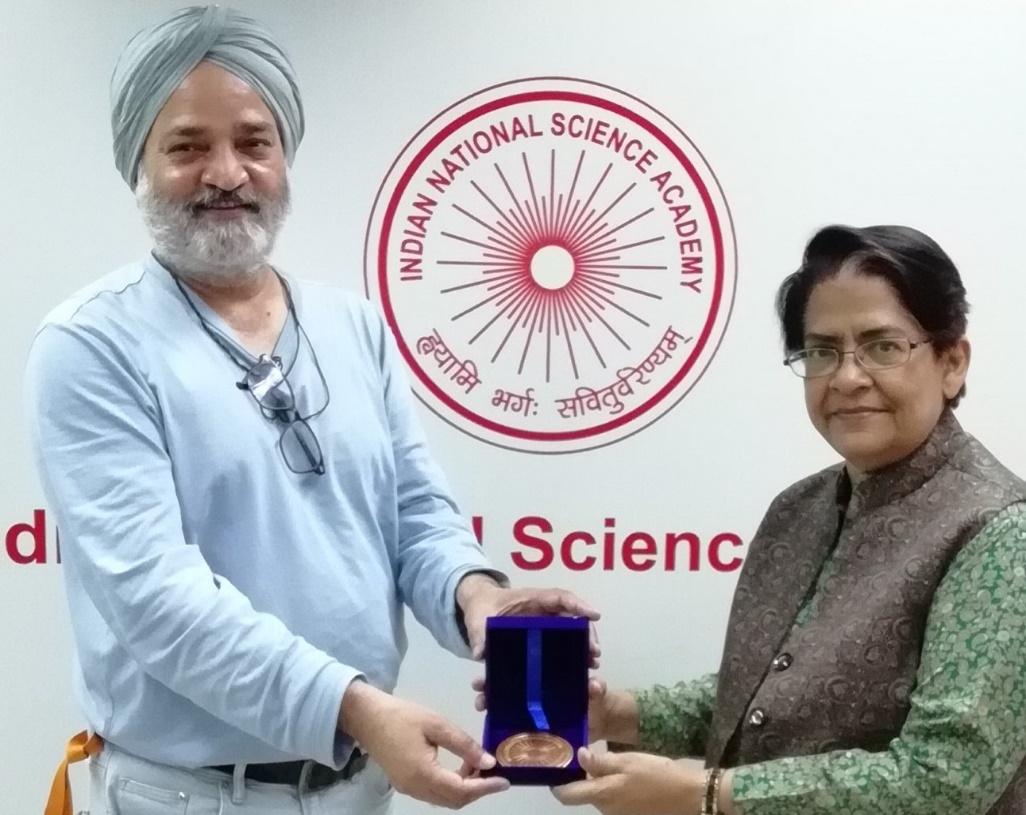
Prof. Chandrima Shaha, President INSA, felicitating Rajinder Singh in Delhi
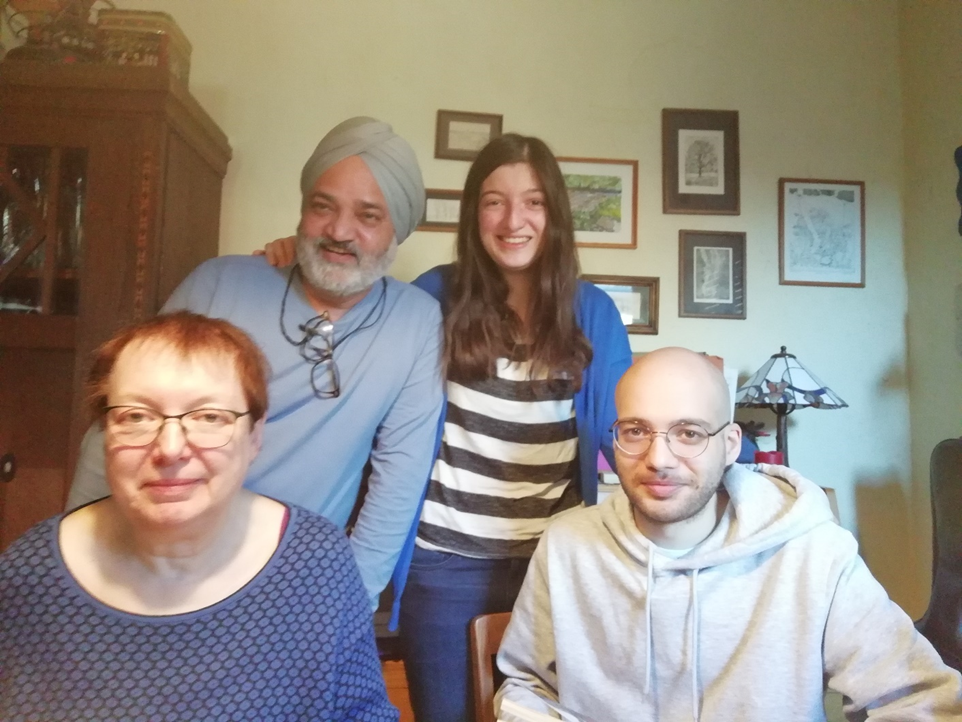
Rajinder Singh with his family (wife, daughter, and son)
REFERENCES
Virk HS. Cosmology in Science and Religion. Proceedings Summer School History of Science, INSA, New Delhi. 1974.
Singh R and Reis F. Seventy years ago – The discovery of the Raman effect as seen from German physicists, Current Science 1998; 74 : 1112-1115.
Virk HS. Book Review: Inside Story of Nobel Peace Prize Award – Indian Contestants. Science and Culture 2016; 82(7-8) : 267-268 .
https://rajindersinghdr.hpage.com/publication-chronicallist.html .
https://rajindersinghdr.hpage.com/projects.html
Virk HS. Book Review: D.M. Bose – His Scientific Work in International Context. Current Science 2016; 111 (10) : 1707-1708.
Virk HS. Book Review. A Jewel Unearthed: Bibha Chowdhury. The Story of an Indian Woman Scientist. Current Science 2019; 116(4): 672-673.
Virk HS. Book Review: C. V. Raman’s Student Sukumar Chandra Sirkar: Life and Science. Current Science 2019; 107(1) : 145-146.
Virk HS. Book Review: Clay, Craft, Music and Science: Purnima Sinha’s Life. Current Science 2020; 118(6) : 988-989.
Virk HS. Book Review: Suprakash C. Roy: A Multidimensional Physicist.
Current Science 2022; 123(4) : 606-607.
Virk HS. Book Review: SD Chatterjee – A Scientist’s Journey from Tradition to Modernity. Current Science (Accepted) .
Virk HS. Book Review: The Dazzling Dawn: Physics Department of Calcutta University (1916-36). Current Science 2022; 122(12) : 1459-60.