Unsung Heroes –
WWII Prisoners of War
by MANPREET KAUR SINGH
Few stories are more inspiring than those of young soldiers who go to
faraway lands to “fight for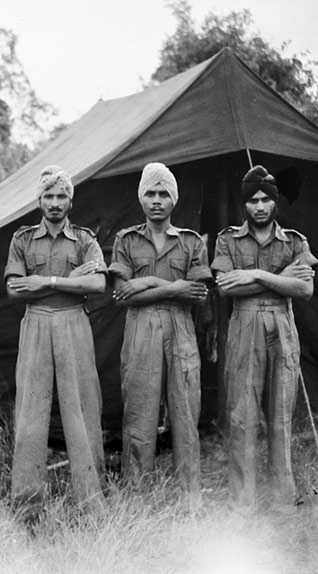 their country and national honour” and who don’t hesitate to lay
down their lives in the line of duty.
their country and national honour” and who don’t hesitate to lay
down their lives in the line of duty.
But what if the country they belong to doesn’t recognize the war
itself, the army they fought for doesn’t accord them any legitimacy, the
enemy captures them and inflicts unspeakable torture on them, but they
still continue to fight with dignity that leaves a life-long impression
on their liberators?
This is the story of thousands of Indian prisoners-of-war
(POW) during World War II, many of them Sikh and Punjabi, who were
captured by the Japanese in 1942, only to be freed by Australian forces
in 1944.
Sadly, the story of these brave men has largely been consigned to
anonymity, with a few historians going even further, questioning their
loyalty and almost heaping them with ignominy. But historical
documents from the Australian War Memorial (AWM) in Canberra claim
otherwise, and testimony from countless Australian soldiers
shows the POWs’ true grit, their steadfast loyalty and their
“greatness in adversity”.
Peter Stanley, formerly the Principal Historian at AWM and now at the
National Museum in Canberra, has painstakingly gleaned the story of
these forgotten soldiers from the records at the National Archives.
His research shows that time and time again, Australian soldiers
remarked that the Indian soldiers were “fine men” and despite
deprivation and severe torture, they had “great soldierly
pride”.
Another described them as “very weak but morale still
high”. One Australian officer, writing about how the soldiers from
the land of the five rivers “inspired” him, declares,
“They are a great race, Sikhs and Punjabis – great in
adversity”.
This officer was a part of the 16th Australian Brigade,
operating around Bolken Point and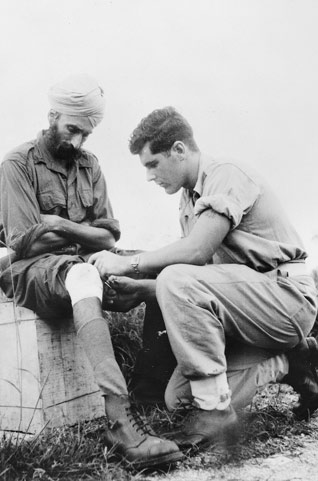 Koanumbo in New Guinea, an area where thousands of Indian POWs were
liberated. He describes how, in May 1945, nineteen Indian
prisoners came to the Australian lines on the 26th, followed
by many more over the next few weeks.
Koanumbo in New Guinea, an area where thousands of Indian POWs were
liberated. He describes how, in May 1945, nineteen Indian
prisoners came to the Australian lines on the 26th, followed
by many more over the next few weeks.
They were weak and ragged, but before mounting the lorry that would
take them to the headquarters, “their sergeant pulled them up and
made them tidy their clothes to the best of their ability, so that they
would arrive at headquarters looking as presentable as
possible”.
Another witness from the 2/8th Battalion described an
“ennobling” experience, when ragged and starving Indian
prisoners-of-war reached the perimeter of the Australian
camp. He recalls how the Havildar in charge pulled
his soldiers into two ranks, saluted smartly and said, “Havildar
(name) reporting with thirteen sepoys, Sir”.
According to the Australian soldier, “This was a moment of great
triumph, not to be forgotten by those who witnessed it”. But
how did these Indian soldiers, fighting for the British imperial army,
get to this bedraggled stage, reach New Guinea and other desolate
islands, only to be freed by the Australians after two years in
captivity?
History books tell us that halfway through WWII, in February 1942,
Singapore fell and the Japanese took many imperial soldiers as
prisoners. Among them, it is estimated that 40,000 were of Indian
origin, and a huge proportion of them, Sikh and Punjabi.
They were separated from the rest of the POWs and subjected to
propaganda to join the Indian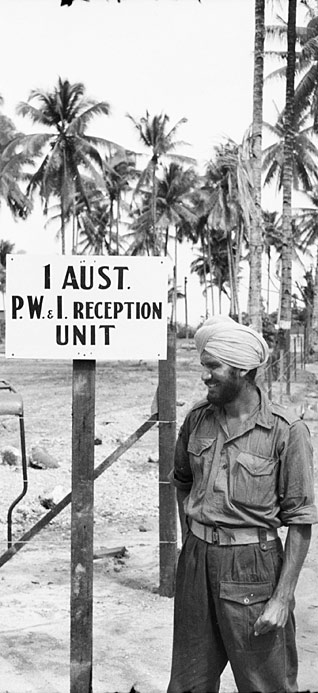 National Army (INA), which at that stage was fighting alongside the
Japanese.
National Army (INA), which at that stage was fighting alongside the
Japanese.
Mandeep Singh Bajwa, director of Center for Indian Military History
explains, “The Japanese, under a brilliant intelligence officer,
Major Fujiwara, had already raised an Indian National Army under the
command of Capt Mohan Singh of the 1/14 Punjab, with a nucleus of
around two hundred Indian soldiers captured during the Malayan
campaign. These soldiers for freedom fought against the British
forces prior to the surrender of 1942.
“Giani Pritam Singh of the Indian Independence League from
Bangkok was instrumental in the raising of the INA and weaning away of
the Indian soldiers to fight for India’s freedom.”
It seems that “up to 30,000 Indian soldiers joined the INA
either willingly or under duress” and the rest, called
“non-volunteers”, were immediately subjected to varying
degrees of torture.
Bajwa says,”The INA had a concentration camp for such cases at
Bidadari where many non-volunteers were tortured, beaten and badly
treated. Capts. Dhargalkar, Badhwar and Ghanshyam Singh were
tortured very badly, the first two being confined to the latrines for
weeks on end, the latter being made to spend months inside a small
cage, where he could neither stand upright nor stretch his
legs”.
Bajwa goes on: “Some other officers, like the brothers Lt. Col.
Gurbaksh Singh, commander of the Jind Infantry unit from the armies of
the Princely States, and Capt. Harbaksh Singh, of the 5/11th Sikh
Regiment, also coaxed their soldiers to refrain from joining the
Japanese. General Harbaksh Singh, as he became later in the Indian army,
has given a vivid account of his days as a POW in his autobiography. All
of them were imprisoned in a camp at an airfield on the Malayan
mainland”.
Although the above-mentioned officers were all awarded MBEs (Member
of the Order of the British Empire) or OBEs (Officer of the Order of the
British Empire) by the British, a large majority of the soldiers in the
Far East campaign were never given any recognition, because of their
perceived association with the INA.
But whether the Indian soldiers joined the INA or not, eventually
they all received the same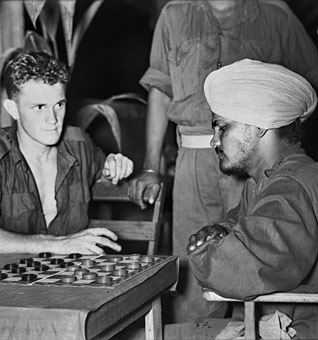 treatment at the hands of the Japanese. By December, 1942,
relations between Capt. Mohan Singh and the Japanese broke down, since
he and other patriots within the INA and IIL were adamant upon Japanese
guarantees of Indian freedom.
treatment at the hands of the Japanese. By December, 1942,
relations between Capt. Mohan Singh and the Japanese broke down, since
he and other patriots within the INA and IIL were adamant upon Japanese
guarantees of Indian freedom.
Bajwa explains: “They wanted a genuine role for the INA in the
attainment of Indian independence. The Japanese, however, had their own
agenda. The result was the arrest of Mohan Singh and his close
associates and the dissolution of the INA till the arrival of Subhash
Chandra Bose in 1943.
“The Japanese, in urgent need of labour for construction work in
the South-West Pacific, used the nebulous situation prevailing
between the dissolution of the First INA and the raising of Netaji’s INA
to ship the Indians to forced labour camps in New Guinea and
Sumatra”.
These forced labour camps seem to be the Asian equivalent of
concentration camps in Nazi Germany. According to Stanley, the
POWs were divided into several Indian Working Parties and around 10,000
Indians (a substantial number of them Sikhs) were sent to New Guinea,
Rabaul (New Britain) and Bougainville and smaller parties to
Admiralties, Timor and New Ireland.
Jemadar Chint Singh has described these camps in great detail in his
testimony to the Australian liberators, especially highlighting the
inhumane way that Col. Takano, his Japanese captor, treated them.
They were made to work for long hours, beaten with wooden sticks if
“they were too slow”, hardly given much to eat, and made to
sleep in a water-logged camp. In his sworn testimony, on the basis
of which many Japanese soldiers and officers were convicted of war
crimes later, Chint Singh recalls “we usually slept in water and
had no sanitary facilities”.
He also testified about an instance in August 1943, when they were
working on an airstrip at Wewak, and Allied aeroplanes bombed the
area. Five or six Indians were killed in the bombing and many
wounded. When Col. Takano heard the wounded cry out in pain, he
reportedly threw sand at them and said, “Why are you crying, this
is not my fault, it’s Roosevelt and Churchill”.
The wounded were not treated and all of them died a short time
thereafter. More testimony appears in a book by John Baptist
Crasta, a head clerk in an Indian Army Service Corps field bakery, who
was captured by the Japanese and sent to Rabaul in 1943. Crasta’s
book, Eaten by the Japanese, was written in 1950, but only
published in 1999. It not only corroborates the inhuman treatment
meted out to the Indian POWs, but also describes systematic cannibalism
practiced by the Japanese, who would pick out a soldier whose flesh they
would eat later in the day!
Despite the unspeakable torture that the Indian POWs went through,
they didn’t lose heart and the Australian records show that they
actually mounted three different protests against their captors at Wewak.
First, in July 1943, the Indian officers submitted a petition
(written in English) to Col. Takano. They asked to be treated
according to the conventions of international law, and to be given
better food, facilities and medical attention.
According to Chint Singh, “Col. Takano was very angry, called us
traitors of Asia and India”, and asked a subordinate to make sure
that they worked even harder.
The second protest probably came after the air raid at Wewak, and
taking a leaf from the Indian independence struggle, the soldiers went
on a hunger strike until their petition was heard. This protest
was led by Capt. Nirpal Chand, a King’s Commissioned Indian officer, who
said, “We will go without food and die, if necessary, unless our
requests are heard”.
The Japanese first threatened to kill them, but later relented, and
conditions improved for the prisoners – but only for six
days, after which “the ill treatment began again”.
The third protest was regarded as most serious by the Japanese
captors. When the landing of American troops became imminent at
Sepik coast, the Indian prisoners were ordered to march 300 kms. from
Wewak towards Hollandia. After walking for about 100 kms., the
troops, under the orders of Capt. Nirpal Chand, refused to walk any
further.
Captain Mitsuba describes Nirpal Chand as “inciting his
subordinates” and fearing “an uprising”, summarily
executed Capt. Chand. Similar instances are quoted by Rabaul
prisoners too, which are described in great detail in the AWM documents,
“War crimes and trials – Affidavits and sworn
statements”.
The first breakthrough for these POWs came in April 1944, when the
1st Cavalry Division seized the Admiralty Islands and
rescued sixty-nine Sikh prisoners of war. They had been used
as labourers at Los Negros and, by all accounts, their presence in
the Admiralty Islands surprised the Allied Forces.
Over the following weeks and months, nearly six
thousand Indian soldiers were recovered from Australian New Guinea
and sent to Recovery of Allied Prisoners of War and Internees (RAPWI)
missions, where they were formally processed as “recovered”
soldiers and shipped