Mekaal Hasan
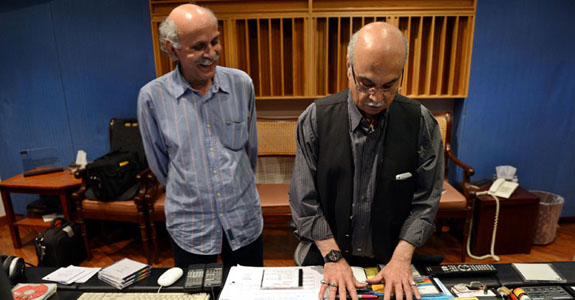
The duo behind the Sachal Studios, Mushtaq Soofi and Izzat Majeed [Photo by Azhar Jafri/White Star]
Sachal Studios is the brainchild of Izzat Majeed and Mushtaq Soofi, is a labour of love for both men. Their passion for music and their own personal experiences with artists have led to a deep-rooted involvement in bolstering the performing arts. In a candid conversation about the music industry’s decline, the lack of patronage for traditional arts, and Sachal Studios’ unique efforts to create a platform for musicians, Majeed and Soofi talk to Mekaal Hasan of the Mekaal Hasan Band about their journey which has led them to create an ensemble that is placing Pakistan on the world music map.
Mekaal Hasan: You have been running Sachal Studios for close to a decade now. You have provided a source of livelihood for many families who would have otherwise suffered because of the demise of our recording industry and the film industry.
Izzat Majeed : The culture of music has been based on film music. All the great musicians and all the great composers created some great sounds, some great compositions. Almost half of them were in classical structures. I don’t know how that has got eliminated in Bollywood but it is atrocious. There is just one keyboard and then you have something called the item song.
MH: So, is music more or less dead?
IM: Yes, it is. And classical music is evaporating. I have been discussing this with Soofi for the last decade that our classical music requires patronage. It had always required patronage — from Akbar down to the Maharajas of Patiala. Now, what is being done in the subcontinent, mostly in India, is that they have hundreds of academies teaching classical music. To my knowledge, not many great musicians have come out of them. As Oscar Wilde said, they know the price of everything and the value of nothing, so they’ll tell you exactly what the raag is but I haven’t seen any younger musician creating massive waves of attention.
MH: One of the main reasons for that is that all the skilled musicians are getting absorbed by the Bollywood industry. You’ll find very fine musicians playing on Bollywood scores because that pays the most. And, while state-funded festivals are happening all the time [in India], most of the classical practitioners are earning mostly from the West, through festivals and concerts. You know how they have residencies in different music schools.
MS: There is a lot of state patronage in India. There are festivals, stipends, institutions and associations. The musicians make a lot of money and the state has huge funds for the promotion of music and arts. In Pakistan, nothing like that happens. The state does not show any interest.
IM: But even though you are right [about India], I haven’t seen any great wave of new classical generation coming about. Some of the old masters are still alive and they are treated with respect and are given their stipends and awards but state patronage can only give you money. The tragedy is that we have no mentor for classical music training.
MS: So, the question is why are there no great musicians despite state patronage [in India]?
MH: There is no demand for classical music at a commercial level [and you can see that] when you compare the amounts of money being poured into Bollywood scores. If there’s no commercial demand for the music, then the musicians have to keep the whole classical scene alive on their own.
IM: No, even the so-called billionaires of India care for music and hold a mehfil (soir´ee) every night. But why does such patronage not reflect in musical innovation? Why does it not reflect in the newer generation creating another interpretation of our classical music? The younger musicians, firstly, don’t have the time to learn classical structures. It’s not easy to learn; it takes years. You can’t just go one day and get a BA in classical music. You need 10 or 15 years [to learn]. The instruments are also difficult to play. So that requires patience; and it requires consistent patronage. The other important factor is that the concept of social time has changed. Nobody is going to sit and listen to eight hours or six hours of a raag.
MH: Attention spans have become shorter.
IM: The attention span is no longer there — even of the singers. I’ve got albums from Siraj Khan and his bhajan stream ends in 15 minutes.
MH: Mr Majeed, what’s your background? Are you are a businessman?
IM: No. That’s a camouflage. I haven’t done a day’s work in my life. I started my career as a lecturer in Punjab University. I got hold of a friend of mine and learned a lot from him about our culture, our music, our poetry that goes back a long way. And then there was this friend who said, okay, let’s start recording. So we did, and recorded Mian Shehryar in 2003, which, I think, is one of our great achievements.
MH: How did you guys then set about formalising Sachal Studios into a fully-fledged world class studio?
IM: That actually took two things: a lot of money and, I think, the good luck of getting hold of Abbey Road Studios in London. They set up the studio.
MH: Is the whole studio custom-designed?
IM: Yes.
MH: Yours is probably the only studio which has been properly designed. How did your vast experience in music help in setting up such a studio?
IM: Vast experience? In what?
MH: In camouflage, possibly.
IM: Listen, music is something you either have in you or you don’t. I don’t believe it can be learnt. There is something in your psyche, in your heart and mind that just keeps you connected to music. From the age of five or six I was immersed in music. At the age of eight, I saw [jazz pianist and composer] Dave Brubek pass through Lahore. Duke Ellington, Dizzy Gillespie, all the giants were there [with him], so I got hooked to jazz. My dad was into jazz but he was also well-trained as an amateur and he used to play music. He was friends with Ali Akbar, who was one of the few people in British India who were allowed 45 minutes of radio time. This was sometime in 1945. So my father imbibed a lot of music and when he came to Pakistan, he had enough going in terms of business. But he was totally taken in by music. He started making films in which the music was always good.
MH: What’s your background Mr Soofi?
Mushtaq Soofi [Photo by Azhar Jafri for White Star]
MS: I have been writing Punjabi poetry and other things. I have been friends [with Izzat Majeed] since the 1970s. I have also worked at television.
MH: How did you guys decided to work together?
MS: It’s only due to enthusiasm that great music gets created. I had some experience of doing it for television and personally knew all the musicians – from the classical ones to the folk singers.
MH: When did you decide to take your interest in music beyond merely being a passive listener or an enthusiast?
IM: I was blessed because Soofi was around. He knows the ABC of music and what it means. [Understanding] what these musicians are all about — that took a while. But now, we are both very comfortable with what we do, which is, basically, looking at the arrangement after selecting compositions. The other thing that we did was to interact with the musicians two or three times a week. We called them home, played all kinds of world music for them. We have been taking them to the BBC proms almost every year for the last three to four years. The first time they went and saw The Royal Albert Hall proms and the symphonies that were being played, they were totally gone. They were crying.
We are also very lucky because maestros like Ustad Nazar Hussain, Riaz Hussain and Mian Shehryar have worked with us. There is a new generation of musicians who are doing quite well in terms of composition. There is this guy called Saawan. I think he has done some very good compositions. We now have the greatest instrument players in Pakistan. They are certainly among the best in the Subcontinent. The tabla player is second to none; the sitar player, the flute player, each one of them is a master.
When we got hold of an orchestra, I didn’t want simple instrumental arrangement; I wanted a symphonic arrangement. When we used to go to London, I would go back to Abbey Road Studios to bring in other instruments which we don’t have in the Subcontinent, like a piano. When the jazz album started, we were already being labelled as producing fusion music.
MH: I think it’s important not to overlook the importance of the social aspect of what you’re trying to do and the fact that you’re personally involved in this work. It is not like you just tell the musicians to insert random flute notes here, or sitar notes there — which is how a lot of such projects are conditioned. Your work is very deep. Both of you have been deeply [involved in it]. And you’ve always been sitting there, in the rehearsals. You are there at the recording. You guys spend a lot of time on it. We continue to crib that music is dying and that there will be no more classical music, or that there will be no more traditional players. But, at the same time, no one really wanted to go and work with the musicians. Working with them is actually the real challenge.
IM: The other thing is that you have to give classical music a new tone to keep it alive. Not a new structure.
MH: So, what is the importance of music that is produced by Sachal Studios? I know we can’t call it fusion.
IM: There is no such thing as fusion music. It is just instruments being used to enhance your own culture. Where is the element of fusion? Unless, of course, you make a fool of yourself and you give credence to the Western way of playing things. What I’m saying is that you bring in your own instruments but the composition and the structure remain theirs — which people do and there’s nothing wrong with that. But, see, it’s not fusion then. It’s their [Western] music getting hold of another culture’s music. Doing our own thing is what we are doing.
MH: But it’s become sort of a populist way of describing music any time a traditional instrument is brought out with a new sound or even when you try and marry it with a new arrangement.
MS: What people mean by fusion is very simple: You get hold of a saxophone and I get hold of a sarangi. You keep on playing yours, I keep on playing mine. This is what the circumstances in Pakistan are.
MH: It’s very difficult to change that…
IM: I am saying something different. I am saying that, strictly speaking, you only have three instruments in India and Pakistan. You have the three-stringed instruments which are the sitar, sarod and sarangi. Some people can say that they are 2,000 years old but that is not true. The sitar that we play today is about 150 years old in terms of its structure. We do not know the structure of the sitar that Amir Khusro made. He may have just put two pieces of wood together. Secondly, sarod was the rabaab of the invading Turks, which Allahuddin Khan added metal strings to.
MH: What was Sachal Studios’ first record?
IM: The first record was [with] Mian Shehryar.
MS: He is generally known as a composer but very few people know that Mian Shehryar was a very good vocalist. Sachal Studios’ first album is also his first album that has his vocals. He composed all the songs and he himself sang them in an inspired way.
IM: It was also a great tribute to Khwaja Ghulam Farid.
MS: It was extremely beautiful, highly inspired.