Ali Arqam
About half a kilometre from Karachi’s famous Banaras Chowk, to the left side of Banaras Nullah, stands a tiny old shop. The exterior is far from impressive; the interior even less so.
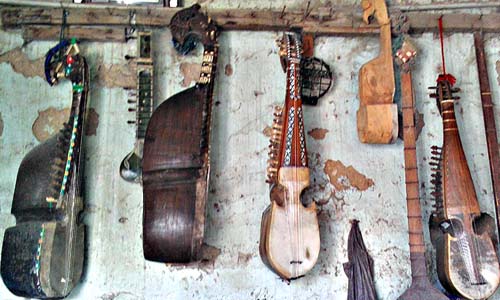
A small space has been cleared out on the floor to provide seating; two old exhaust fans are tied to the roof in place of ceiling fans and all the remaining space is taken by musical instruments, stacked in the corners, hanging from the walls and piled up wherever there is an inch to spare. Some are finished and ready to play; others are broken and need to be fixed.
This is the famous Shaheryar Musician House owned by Sohail Muhammad, the sole rubab maker of Karachi.
The Pakhtuns who came to Karachi seeking their livelihood brought many of their traditions and customs with them. One beautiful tradition is that of the majlas; a gathering of professional and amateur singers and musicians who take this opportunity to perform, earn their living and provide a few hours of entertainment to the appreciative audience. While other musical instruments also make an appearance, the rubab is considered the essential piece at such events.
In Karachi, however, the character of the majlas is a bit different from those held in the villages; due to a dearth of professionals, amateur singers who spend their days toiling at hard labour shed their cares and revel in traditional folk poetry accompanied by the melodious strains of the rubab.
Enthralled by the idea of participating in one of these majlas, my younger brother, a business student aspiring to get enrolled at the National Academy of Performing Arts, made up his mind to learn to play the rubab, which took me on a journey to Shaheryar Musician House.