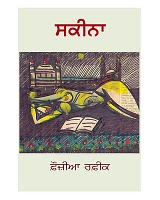
by Fauzia Rafique – Roop Dhillon
Every so often an important novel is written, enriching the canon of Literature of Punjabi. Skeena , a novel by Fauzia Rafique is one of those. initially released in Pakistan, available only in Shahmukhi script. It was released in 9 cities there, and was a resounding success. This is of course very positive for Punjabi, a language neglected on it’s home ground, especially in Pakistan, and positive for Fauzia Rafique, for her novel does not pull any punches, nor does Skeena shy away from often taboo themes in Islamic society, and indeed all Punjabi communities. To place it in a genre, one could call it Feminist Literature. That in itself is amazing, as it has gained kudos in Pakistan , considering the environment there since Zia, and definitely since 9/11. The book was released last month in Canada both in the Gurmukhi transcript ( The version I have read) and translated in English. I think indeed it should be translated into French and Spanish as well.
Skeena , is a journey of a smart girl, who questions everything. We meet her at the age of seven, and the story then takes us to young adulthood, into the Pakistan of General Zia, to Canada , and a forced marriage with a complete stranger to finally finding love with the last person she expected under the Sun amongst the Blueberry fields of BC. This is no Hollywood saccharine filled story, or Bollywood fake fantasy, or despite what I have said stereotypical, east is worst and west is best plot. Skeena is the stark and true experience typical of many a Punjabi woman, in this case bought up in Islamic Culture, but it can so easily apply to those women bought up in Sikh or Hindu culture as well. What is the common factor? Punjabi attitudes.
Reading Skeena, bought up many issues for me, general themes and points significant to the state of Punjabi Literature today. I think it needs to be examined in the context of these issues.
Techniques in how to write prose have moved on a lot in the last 100 years. The other factor that has moved on is the subject matter and how honestly it is dealt with. What may have seemed great in Russian and English literature ( other than Urdu and Hindi, the greatest influencers on Punjabi language in the last 100 years) in Victorian times, and pre-partition India / Pakistan is now stale, boring and irrelevant. There has been a malaise in Punjabi literature, confounded, I think by the following factors.
1) Male domination in writing
- 2) Religious domination, but often the incorrect interpretation of the faith
- 3) Sycophantic behaviour of the established writers
- 4) Greedy Printer Publishers
- 5) Political strangulation of the artist
- 6) The public itself not reading
- 7) Writers life experience only restricted to the village
- 8) Conservative values