Trade Union and Working Class Struggles: Makhan Singh and the TU Movement in Kenya .
Department of Applied Social Sciences, London Metropolitan University . 17 February 2010
Makhan Singh, the family man
– Inderjit Kaur Gill–
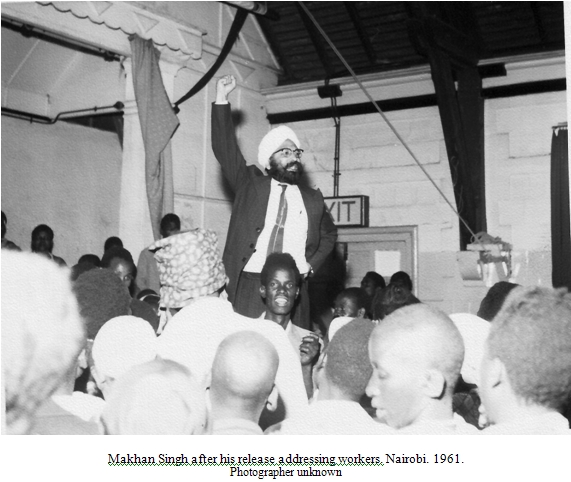
It gives me a great pleasure to stand here today and pay homage and tribute to my father, Makhan Singh, on behalf of his family, especially my brothers Hindpal Singh Jabbal and Sawrajpal Singh Jabbal.
Shiraz Durrani has just presented the political aspects of my father, Amarjit Singh Chandan has thrown some light on his literary qualities and I would like to talk about his personal, family attributes, which I have compiled from my own and my family’s feelings, recollections and experiences. As he was a very private, detached and aloof person none of us really got to know him well. From now on I would like to refer to my father as Papa ji – Punjabi word for Dad – makes it rather personal and special for me.
Brief life history
Papa ji was born on 27th December 1913 in the village of Gharjakh , District Gujranwala West Punjab and spent his early years in utter poverty and very difficult circumstances. He was only seven, when his father, Sudh Singh left for Kenya to join the Railways as an artisan, leaving Papa ji and his younger sister, in the care of their mother. For the next seven years he studied in various Sikh Missionary schools in and around his village. It was also during this period that the incident of Jallianwala Bagh took place, in which several hundred innocent and defenceless Indians were massacred in Amritsar in cold blood by General Dyer. This incidence, the Sikh scriptures which he listened to at the local village Gurudwaras (Sikh temples), the Sikh history of martyrdom and self sacrifice that he may have read or experienced in his formative years, left a lasting impression on the young mind of Papa ji.
Papa ji first came to Nairobi at the age of 14, together with his mother and sister, to join his father, who by now had started a small contracting business and a part-time printing press. Papa ji was a very bright student and passed his London Matriculation examination in 1931 from Government Indian High School (Duke of Gloucester School for Boys and now Jamhuri High), where ex-Chief Justice of Kenya, Hon. Chunilal Madan was his classmate and later assisted him with legal services. He joined his father’s printing press to give him a helping hand as he could not be sent overseas for further studies due to financial difficulties. It was during this period that he started taking keen interest in the labour trade union movement.