Rakesh Krishnan Simha
Marshal Gregory Zhukov, the legendary Russian commander, said the Macedonians had suffered a catastrophic defeat in India. In the final part of this analysis, fact and fiction are separated.
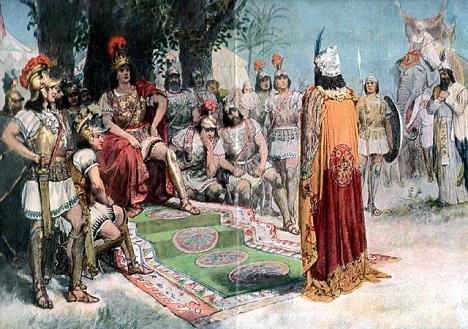
Alexander meets Porus. Source: wikipedia.org
After defeating Persia in the year 334 BCE, Alexander of Macedon was irresistibly drawn towards the great Indian landmass.
However, the Persians warned him the country was no easy target; that several famous conquerors had fallen at the gates of India.
The Persians told him how their greatest king, Cyrus, who had conquered much of the civilised world, had been killed in a battle with Indian soldiers exactly two centuries before Alexander.
And in an earlier antiquity, the Assyrian queen Semiramis, who had crossed the Indus with 400,000 highly trained troops, escaped with just 20 troops, the rest being slaughtered by the Indians.
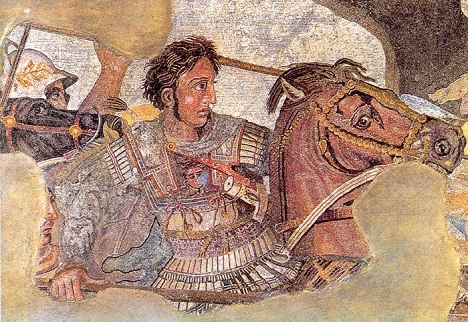
Marshal Zhukov on Alexander`s failed India invasion
In his book, Foreign Influence on Ancient India, Krishna Chandra Sagar says 150 years before Alexander, Indian archers and cavalry formed a significant component of the Persian army and played a key role in subduing Thebes in central Greece.
Alexander, however, knew no fear. More than anything else, he wanted to invade India. It would prove to be a strategic blunder.
Zhukov’s take
“Following Alexander’s failure to gain a position in India and the defeat of his successor Seleucus Nikator, relationships between the Indians and the Greeks and the Romans later, was mainly through trade and diplomacy. Also the Greeks and other ancient peoples did not see themselves as in any way superior, only different.”
This statement by Russia’s Marshal Gregory Zhukov on the Macedonian invasion of India in 326 BCE is significant because unlike the prejudiced colonial and Western historians, the Greeks and later Romans viewed Indians differently. For instance, Arrian writes in Alexander Anabasis that the Indians were the noblest among all Asians.
In fact, Arrian and other Greeks say the Indians were relentless in their attacks on the invaders. They say if the people of Punjab and Sindh were fierce, then in the eastern part of India “the men were superior in stature and courage”.
All this is glossed over by Western historians, in whose view the one victory over king Porus amounted to the “conquest of India”. But the Greeks made no such claim.
Battle of Hydaspes – Hardest ever
Greek contemporary writers describe the Battle of Hydaspes (Jhelum) as the hardest fought of all Alexander’s battles. Frank Lee Holt, a professor of ancient history at the University of Houston, writes in his book, Alexander the Great and the Mystery of the Elephant Medallions: “The only reference in Arrian’s history to a victory celebration by Alexander’s army was after the battle with Porus.”
Alexander’s army did not indulge in celebrations after the Battle of Gaugamela where they defeated 200,000 Persians. No wild festivities were announced after the Battle of Issus where they defeated a mixed force of Persian cavalry and Greek mercenaries.
The fact they celebrated after the Battle of Hydaspes suggests they considered themselves extremely lucky to survive after the clash with the Hindu army, with its elephant corps.
If Porus lost, why reward him?
According to the Greeks, Alexander was apparently so impressed by Porus he gave back his kingdom plus the territories of king Ambhi of Taxila who had fought alongside the Macedonians.