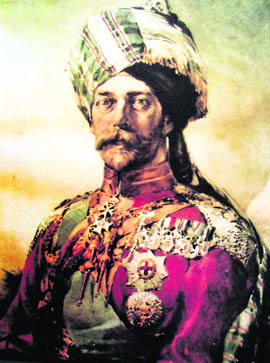
A handsome volume published recently by the Police Academy about
the Fort of Phillaur absorbingly guides one through the haze of the past
by recalling days and reconstructing an ambience
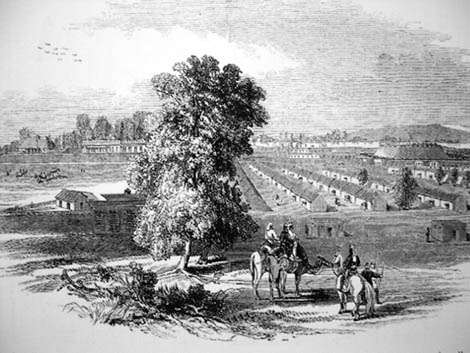
A view of the river taken from the Fort at Phillaur. Old engraving
by a European artist; 19th century
 WHATeVER perceptions anyone might have about the police in our land, I am convinced that the force has a clear sense of history. This came home to me a few years ago when I had the pleasure of being in the company of Rajdeep Singh Gill, who was then Director of the Punjab Police Academy at Phillaur, and who took me around the Fort Museum set up on the premises of the academy.
It was heart warming. For, one could feel the breath of history on every display, each object. There they were: yellowing documents that evoked a whole era; resplendent old uniforms that still glistened; memorabilia that were truly soaked in memories; antiquated objects wearing with distinction the patina of time; photographs that reminded one of the pride with which officers had headed the institution — from G.A. Rundle of the end of the 19th century, through the legendary Ashwini Kumar, the first Indian officer to occupy that position, up to the distinguished gentlemen of recent years. There was history all around.
My impressions were all confirmed when I came upon a handsome volume published recently by the Police Academy on the Fort of Phillaur. Two hundred years had passed since the Fort was built, and there was occasion to celebrate. From everywhere the two editors of the volume, Rajdeep Gill and D. J. Singh, had, therefore, been gathering material: from documents that formed part of the records of the academy, from officers past and present, whose memories stretched back to old days, from sheaves of photographs in which memories were preserved, from old travel accounts left by foreign visitors to the Punjab, from scholars who knew what fort building was all about, and so on. Painstakingly, a picture had been pieced together and one was guided by the volume through the haze of the past.
|
|