A Captivating Symphony of Senses: A Review of "Fragrance of Seven Colours "
Azam Ismail
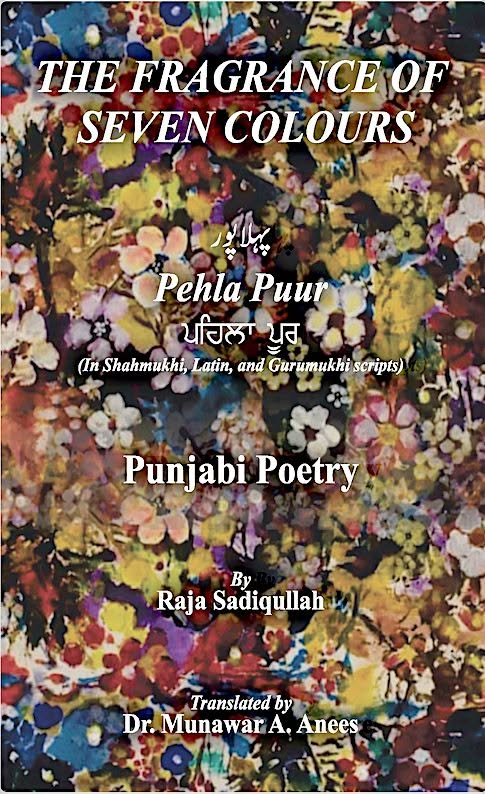
"Fragrance of Seven Colours " is not merely a book of translated poetry; it is a meticulously crafted portal. Originally published in the two great scripts of the Punjabi language—*Gurmukhi* (used predominantly in Indian Punjab) and * Shahmukhi * (the Perso-Arabic script used in Pakistani Punjab)—this collection arrives in English as a monumental gift to world literature. It is a bridge woven from linguistic and cultural threads that feels both authentically rooted and profoundly universal.
The poet’s voice, as rendered in this translation, operates on a dual register. It is at once the intimate whisper of a solitary soul observing a dew-laden spiderweb at dawn and the resonant chorus of a community singing in the fields. This duality is the collection's core strength. The verses perform a sacred alchemy, blending the ephemeral with then eternal: the fleeting fragrance of a night-blooming flower becomes a metaphor for memory, while the robust, enduring weight of a clay water pot speaks of ancestral wisdom and resilience. The "seven colours " of the title are revealed not as a literal spectrum but as the prismatic facets of lived experience—love, longing, grief, celebration, devotion, rebellion, and homecoming—each emitting its own unique olfactory and emotional aura.
*The Art of Translation: A Bridge of Soul and Sound*
To praise the translation as "masterful" is to only begin the conversation. The translator, *Dr. Munawar A. Anees, acts here as a cultural mystic and a linguistic musician. Punjabi, with its earthy textures, musical tonality, and proverbial depth, presents a formidable challenge. This translation moves beyond semantic fidelity to achieve *sonic and sensory fidelity. The reader can feel the crunch of wheat stalk underfoot, the sizzle of cumin in hot ghee, and the melancholic swell of a shahnai on the evening air. Dr. Anees makes a critical choice to preserve the conceptual and imagistic richness of the original, often finding ingenious poetic equivalents in English rather than clinging to literal words. The rhythm, at times percussive like a bhangra beat, at times flowing like the five rivers of the land, is maintained with exquisite care, allowing the English verses to breathe with the same life as their Punjabi ancestors.
*Thematic Depth: From Soil to Spirit*
The poems traverse a breathtaking emotional and philosophical landscape. They are anchored in a deep geo-piety—a spiritual reverence for the land. This land is not a passive backdrop but an active character: a mother, a lover, a witness, and a tomb. The poems of agrarian life—of sowing, waiting, and harvesting—become potent allegories for human hope, patience, and cyclical renewal.
Alongside this terrestrial bond runs a current of profound *mystical yearning. Longing for the beloved (* ashiqui ) seamlessly transforms into longing for the divine ( ishq ), blurring the lines between romantic and spiritual desire. This confluence is a hallmark of the Punjabi poetic tradition, and it is presented here with a freshness that feels both ancient and immediate.
Furthermore, the collection does not shy away from the grit of existence. Poems of *resistance and lament* give voice to the struggles of the marginalized, the pain of separation, and the scars of history. Yet, even in these, there is an undeniable, resilient pulse—a celebration of the human spirit that, like the hardy sugarcane of the region, bends but does not break.
*Structure and Pacing: A Curated Journey*
The arrangement of the poems is itself a narrative. It mimics the arc of a day, a season, or a life. It begins with then gentle, hopeful hues of dawn and awakening, builds into the vivid, chaotic, and passionate colours of noon and labour , mellows into the reflective tones of twilight, and settles into the profound, star-studded contemplations of night. This careful curation allows the reader to journey rather than simply read, making the book an experiential whole greater than the sum of its stunning parts.
*In conclusion, "Fragrance of Seven Colours " is a literary and translational triumph of the highest order.* It is a book to be savored slowly—a poem at a time, like a precious spice allowed to dissolve on the tongue, releasing layers of meaning. It is an essential read not only for connoisseurs of poetry but for any seeker of beauty, any student of humanity, and anyone who believes in the power of art to transcend borders and touch the universal core of feeling. This collection does not end on the final page; it plants itself in the reader's consciousness, where it continues to grow, bloom, and release its captivating fragrance long after the cover is closed.