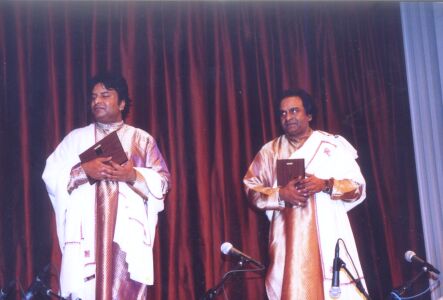
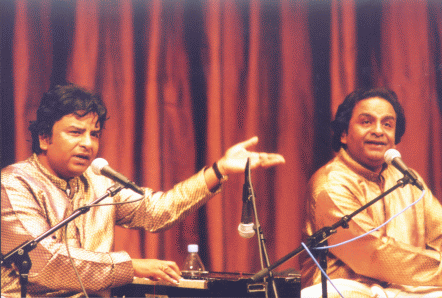
Niazi Brothers’ Concert
APNA's Fourth International Punjabi Conference 10 of 36 Next:
APNA's Dinner with Zia Shahid →
Program Notes


Opening Remarks - Safir Rammah
Opening Remarks
Safir Rammah
The Indians and Pakistanis need no introduction. For those who don't understand Punjabi, I hope you had a chance to look at the program notes. I am sure that many of you are familiar with Sufi thought and with Arabic and Persian Sufi Poetry. Let me just say a few words about what distinguishes Punjabi Sufi poetry from other Sufi traditions:
In India, there were and are many different Sufi schools of thoughts. Among Muslims Qadaria, Chishtia, Malamti and others and then of course Hindu mystics and Sikh Gurus.
Punjabi Sufi poets didn't all belong to the same Sufi School but they had many common characteristics that allow us to put them in a class of their own and talk about them as Punjabi Sufi poets, even though they were not all followers of a single school of thought.
Let me just highlight those common characteristics:
· First and foremost was their choice of language. Since the beginning, Sanskrit and then Persian were the languages of power in India. Persian was brought by the Muslim rulers and became the language of Delhi's court in the 10 and 11th century and remained so until it was abolished by the British rulers in 1837 and replaced by English
· Punjabi Sufis, beginning with Baba Farid in the 12th century, made a very important choice and started a tradition of writing Sufi poetry in Punjabi, the local language of people. That was a key choice that brought them closer to the people instead of the seats of powers in Delhi or Lahore and Multan.
· With that they also dropped all pretensions of writing poetry for an elite class of intellectuals and instead of adopting the intricacies and complexities of Persian poetry they used the very simple idiom of village folks and used the imagery, symbols, and metaphors that were taken from the daily lives of Punjabi villagers. Throughout the 800 a or so years of Punjabi Sufi poetry, this remained the hallmark of these poets
· Secondly, they added a few very important elements in their Sufi thought to address the practical problems faced by the multi-religious land of Punjab and adopted their message to the local conditions. Besides love for God and their murshid, or teacher, a very important part of their message is love for people. and how to live in harmony by diffusing the religious differences
· They did that by challenging the religious dogma and the religious and political establishment of their time. For them peace and harmony in the society were more important then the narrow confines of any one religious prescription. They preached and taught people to rise above the religious differences and develop mutual understanding and tolerance for the many competing religious ideologies.
· For them these different ideologies were simply different paths leading to the same goal of a union with God or ultimate Truth that they believe could not be achieved without love for human beings. As Mian Muhammad had said: Masjid dhaa de mandir dhaa de, dhaa de jo kujh dhainda/ Ek bandian da dil na tureen, sohna Rub dillan wich rehnda (I wouldn't care if you demolish these mosques, mandirs and all other symbols of religious dogma/ Don't break the heart of a human being because it is the seat of Allah).
· Finally they wrote their poetry for the purpose of singing and set their lyrics in the classical Indian ragas or in folk tunes
Their poetry was mainly an oral tradition and was transferred from one generation to the other through singing. Even today, if we visit the Shrine of Baba Farid at Pakpattan or of Sultan Bahu at Shahkot on the bank of Chenab or Shah Hussain's Shrine in Lahore, from morning till night and even during the night, we can see groups of fakirs and singers sitting on the ground with their simple instruments, singing the same poetry we are going to hear tonight.
In each generation, many singers dedicated their lives to singing Sufi poetry. That is how it got to Niazi Brothers' father, Tufail Niazi, who became a legend during his lifetime and then passed it on to his sons Babar and Javaid who are now keeping that tradition alive and have today brought Punjabi Sufi poetry and music to the Mall, in this beautiful auditorium ....
Washington Post - January 13, 2003
Washington Post, January 13, page: C-05
Niazi Brothers
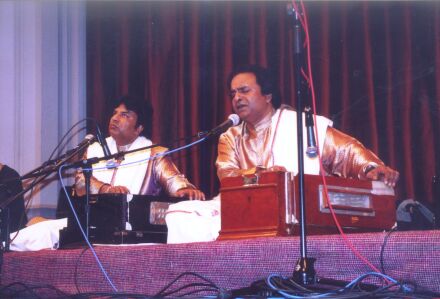
Last summer's Smithsonian Folklife Festival presented dozens of musical virtuosos from the Near and Far East, but under less than ideal circumstances for careful listening. Saturday night at the Freer Gallery, however, one of the festival's acts was able to perform at length in a less distracting venue. Accompanying themselves on harmoniums, Pakistan's Niazi Brothers sang Sufi poems and Punjabi folk standards for more than three hours.
The melodies in the first part of the program were derived from classical ragas, although the music's structures and rhythms were less complex. Javaid and Babar Niazi sang in rich, sweet tones but without the intricate interplay of classical Indian music or the call-and-response vocals of larger groups that perform qawwali, Sufi songs of devotion. One of the lyrics was by Guru Gobind Singh, a 17th-century Sikh saint; during that song, many turbaned men came forward to place monetary offerings on the stage.
After the intermission, the Niazis sang folk material, which was generally livelier and more dance-oriented. An excerpt from "Hir Ranjha," an 18th-century epic poem, was hushed and rhythmically free, but most of the songs were thumping and ecstatic, with melismatic vocal lines and singalong choruses.
Dr. Manzur Ejaz - Daily News, January 19, 2003
The Real Goodwill Ambassadors (Niazi Brothers)
Dr Manzur Ejaz
The Daily News, January 19, 2002
After a slightly delayed jumpstart, Pakistan's ambassador, Mr Ashraf Jahangir
Qazi, has been on a whirlwind tour to console and mobilise Pakistani Americans
against discriminating INS registration law. Pakistani immigrant community is
trying its best to change its image in the US through various means. Certainly,
pair of musicians, Niazi brothers, Javed
and Babar, were the best envoys to convince the Americans that Pakistan is much
more than just a jihad-producing factory. By their excellent performance they
showed to the international audiences that Pakistan, and their native Punjab, is
still the centre of great art, literature, culture and civilisation. Therefore,
instead of spending millions on useless public relation firms, Pakistan needs to
send more artistes like Niazi brothers.
The most prestigious US cultural institution, the Smithsonian, in its Freer
Gallery, hosted Niazi brothers' music concert. The demand for the concert was so
high that hundreds of music lovers could not get in because the show was fully
pre-reserved a week earlier -- all tickets to the show were taken within a few
days of announcement. As expected, bulk of the audience was Americans and
Indians (East Punjabis in particular) while Pakistanis were few in number which
was not very encouraging to say the least.
Niazi brothers' concert was organised by the Academy of the Punjab in North
America (APNA). In itself, APNA
is a unique non-religious, non-political organisation of Punjabis of all
religious persuasions. Its membership is evenly divided between immigrants from
both sides of Punjab and Punjabi Diasporas. It is extremely significant that,
unlike many Indo-Pak cultural organisations, this cultural association has
managed to survive for over a decade with no
significant internal friction. More importantly, the organisation is credited
with a substantial work in transliteration of Gurmukhi-Shahmukhi (Punjabi
written in slightly modified Persian script) books and making them available in
both parts of the Punjab. APNA's last major project was publishing of Kalam Guru
Nanak from Lahore. The organisation is in the process of transliterating Prof
Sharif Kunjahi's excellent Punjabi translation of the Qur'aan and making it
available to Gurmukhi readers. Niazi brothers were the most befitting artistes
APNA should have promoted in
Washington.
Niazi Brothers presented a wide variety of Sufi and folk songs from Punjab. In
the first half they sang great classical poetry of Sultan Bahu, Bulleh Shah,
Shah Hussain, Mian Muhammad Bakhsh and Khawaja Ghulam Farid with such a passion
and devotion that kept the audience spellbound. Their own composition of Guru
Gobind Singh's famous verse 'O sada hal murida da mittar piaray noon kahna'
brought tears to every eye whether the text was understood or not. In the second
half, they dwelled on great qissa (legends) tradition and famous folk songs.
They also presented two poems
of legendary poet Shiv Kumar Batalvi.
Niazi brothers' performance was so enchanting that even the Washington Post's
music critic, Mark Jenkins, had to take a note. In his detailed column, Mr
Jenkins generously praised the singers in saying that "Javaid and Babar Niazi
sang in rich, sweet tones but without the intricate interplay of classical
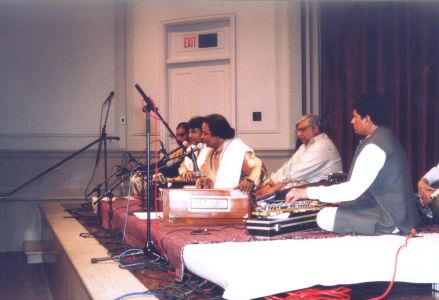
Indian music..." He also admired the accompanying instrumental musicians, tabla
player Haroon Alam and banjo player Mohammed Bashir.
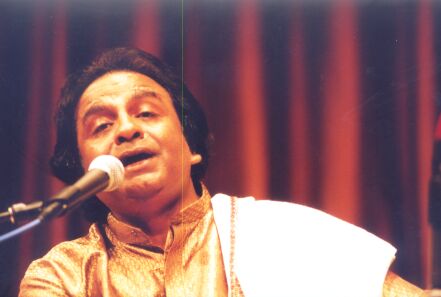
Javaid and Babar Niazi are carrying the great tradition of their father,
legendary folk singer Tufail Niazi. Javaid not only resembles his father in
appearance but also tries to capture intricacies of music Tufail Niazi was known
for. Babar compliments his brother beautifully and creates a pleasant impression
with his own composition of folk songs. Both brothers make a formidable team of
rising stars on the music horizon. They, like their father, can sing
semi-classical compositions as well as folk tunes. Probably, they add extra
dimensions to apparently one-layered folk songs through their unique style:
Their singing of simple folk songs in classical embedded compositions gives
deeper meanings to even
simple texts.
Niazi brothers are a class apart from many modern folk singers for whom the loud
and fast rhythms are primary and the verses are secondary. Furthermore, unlike
many new singers Niazi brothers are well trained in music and have a deeper
comprehension of Punjabi poetry. They have the honour of performing in Bombay,
Delhi and Chandi Garh in India besides US, Canada, UK, Germany, Middle East,
China, Singapore, Malaysia and Australia. Both brothers were awarded gold medals
in Spring Festival of Pyongyang in North Korea. They also represented Pakistan
in a Sufi festival in Oslo, Norway.
However, despite their long list of achievements, they still lack the exposure
Tufail Niazi had during his career as a leading exponent of naqals (form of
village theatre), and singing in front of large crowds in rural and urban
festivals all around Punjab. Tufail Niazi had a unique edge over other legendary
folk singers due to his mastery over the compositions nested in classical
tradition. Often he instilled new and different meanings into common verses. No
wonder, Tufail Niazi had the honour of being the first person to appear on PTV
on its inauguration day.
On a different note, Pakistani diplomats are trying very hard to convince the US
authorities to show leniency in implementing the new immigration rules. Foreign
Minister, Khursid Mehmood Kasuri is visiting Washington next week to persuade
the US government to treat Pakistanis with honour and dignity. No one believes
that he can succeed in having the discriminatory immigration law changed. As a
matter of fact many opine that he and other top Pakistani
leaders are doing a disservice by creating an impression that the US can change
its immigration rules with Islamabad's prodding. For now many affected
individuals have adopted a wait and see policy and only six Pakistanis have been
detained. However, it is only the beginning and no one knows the end.
Some Audio Recordings
Photo Gallery