Release of Kalam Baba Nanak in Shahmukhi
RELEASE OF
KALAM BABA NANAK
Shahmukhi Version
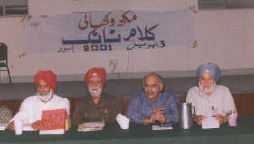
On April 3, 2001, Academy of the Punjab in North
America ("APNA") and Punjab Heritage Foundation
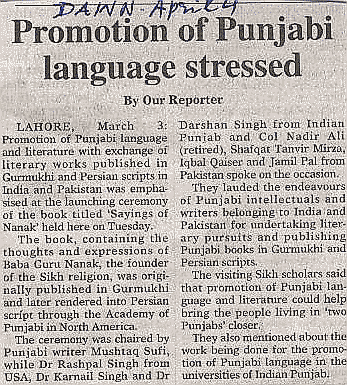
released the Shahmukhi version of Kalam Baba Nanak in Lahore.
This historical ceremony was held at Lahore Press Club and was attended by a large number
of Punjabi writers, intellectuals, journalists and many others.
The ceremony began promptly at 5:00 PM in the main hall of Lahore Press
Club that was filled to capacity by a large audience. Mushtaq Sufi
presided the meeting and Iqbal Qaiser performed the role of stage
secretary.
 In his opening remarks, Iqbal Qaiser
introduced APNA to the audience. He noted that one of the
main objectives of APNA is to publish important books of Punjabi in both
Shahmukhi and Gurmukhi scripts to make all major writings in Punjabi available on both
sides of the border. By publishing Kalam Baba Nanak in Gurmukhi, APNA
and Punjab Heritage Foundation have reached an important milestone in
their efforts to break communication barriers between the two Punjab’s.
Jamil Pal presented his paper on the problems and
obstacles that the publishers had to face in transliterating Kalam Baba Nanak. He said
that it was quite difficult to type Kalam Baba Nanak in Shahmukhi scripts
since the writing is very old and no proper software in Shahmukhi is available to
accurately transcribe it.
Shafqat Tanveer Mirza presented his paper on Kalam
Baba Nanak. He described in detail the linkage between Kalam Baba Nanak
and the tradition of Punjabi spiritual literature. Col. Nadir Ali recited some parts of Kalam
Baba Nanak. In his remarks, he pointed out that Kalam Baba Nanak
is part of our literary heritage. After partition, the new generations in West
Punjabi’s have forgotten the highly important place of Kalam Baba Nanak
in our literary tradition. He said that publication of Shahmukhi version of Kalam
Baba Nanak would once again revive the understanding and appreciation of Kalam
Baba Nanak in West Punjab.
 Dr. Rashpal Singh, who had come
from the United States to attend this function, said that we are running three Punjabi
organizations in the USA, APNA, Punjab Heritage Foundation
and Sikh Foundation and we are proud to say that we jointly work together
on many important projects. The joint publication of Kalam Baba Nanak by
APNA and Punjab Heritage Foundation is one such example. We are jointly
working to promote our language and culture to bring all Punjabi’s closer to each
other.
 Dr. Darshan Singh, Professor of Guru
Nanak Chair at Chandi Gargh University discussed the unique features of Punjabi
Literature and presented his views of Guru Nanak as a poet.
 Karnail Singh Thind gave the main
talk of the meeting. He spoke about the differences of various scripts in two
Punjab’s, the problems of translating Shahmukhi script, and other issues relating to
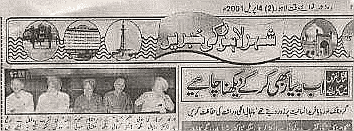
Punjabi literature. Some of his statements made headlines in the West Punjab newspapers. He
said that it is Punjabis of both sides of the border who ultimately die in any clash
between India and Pakistan. If the tension between the two countries will continue, our
next generation will not forgive us. We have spent the last 53 years in hatred, now let us
try to live with love. He said that there is not much difference between Baba
Farid and Baba Nanak’s poetry. If today Punjabis could come
to their senses, the relationship between the two Punjab’s and the two countries
could change overnight. He said you Muslim go to Mecca, but our Mecca is in your side of
the Punjab. He also announced that Punjab Heritage Foundation has decided
to give annual prizes of 50,000 and 10,0000 respectively to the authors of top two Punjabi
books irrespective of the script they are written in. Hesaid that Punjabi is being taught
in seven universities of East Punjab. Although Punjabi teaching in East Punjabi is in Gurmukhi, one paper in Shahmukhi script is mandatory for
post-graduate studies in Punjabi Literature. He said that Guru Nanak has
three "roops"; the Guru; the philosopher and the poet.
 At the end, Mushtaq Sufi thanked the
audience. After his remarks, the formal ceremony of Kalam Baba Nanak’s
"Mukh Wikhali" was performed. The function was highly successful in all
respects. Not only that it was attended by a large gathering of Punjabis from all walks of
life, it was widely reported in the media on both sides of the border.
BACK TO 
HOME PAGE