

Mushtaq Soofi
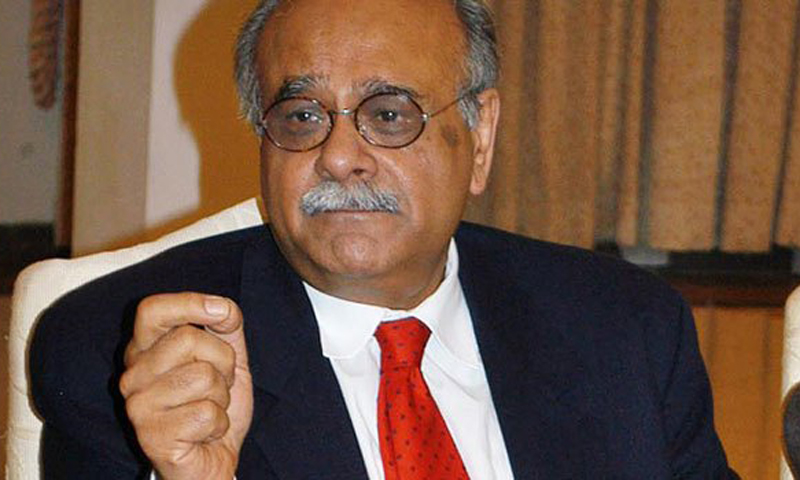
Caretaker chief minister of Punjab Najam Sethi. — File Photo.
Najam Sethi, after taking over as the care taker chief minister of Punjab, took some measure galvanizing the cultural scene that would have attracted little attention in the normal circumstances but as we all know, we do not live under normal circumstances in the cultural sense.
Thus his action is being perceived as very significant in view of the self- induced cultural amentia the Punjab suffers from. In order to appreciate the implications of his cultural activism we need a perspective. The Punjab these days seems to be a cultural wasteland despite having more than 5,000 years glorious history. In view of our intellectual inertia, it will seem hard to believe that it was Punjab that created what we call civilization of the subcontinent as a result of confrontation and interaction between the Dravidians and Arya.
It was Punjab where the Rig-Veda was composed or revealed to the ‘Rishis’, the sages. It was the universally celebrated Taxila University in the Punjab where great Panini wrote his Ashtadhyayi, the first book on linguistics and Chanakya Kautilya his famous Arthshastra, analyzing the dirty but real secrets of stat-craft for the first time in the recorded human history.
Ghandhara in Punjab produced some of the finest pieces of sculpture. And again it was Punjab that laid the foundations of synthetic Hindu Muslim culture after the arrival of Arabs from the south and that of Turks from the north, leaving indelible imprint on our collective life.
The visible sign of our cultural deterioration and decline is the disowning or rejection of our language by our elite, wallowing in its self created arrogant ignorance. If you lose language, the most vital element of culture, you are destined to lose your culture as it is language that enduringly preserves and transmits collective memory from generation to generation. Not just that! Language is a mode of thinking and each language has a mode of thinking specific to it. So by losing your language you lose your intellectual and spiritual evolution as well as your specific way of thinking.
The rot, as far as our language is concerned, started after the annexation of the Punjab by the British in mid-nineteenth century. The British colonial administration deliberately demolished the vast network of indigenous system of education. The use of the Punjabi, the Persian and the Sanskrit was almost banned in the new European type schools set up by the colonialists where English was adopted as medium of instruction for upper class and Urdu for middle and lower classes. Soon after the demolition of old educational infra structure, Punjabis were declared illiterate and ill cultured as Dr GW Leitner, one of the most celebrated linguists and educationists, pointed out in his famous survey known as ‘A report on education in the Punjab’. According to Leitner’s findings Punjab was not only most literate in the entire subcontinent but also had the highest female literacy rate.
011 census has already drawn criticism from various quarters for massive inaccuracies,” writes the author. He demolishes, in no time, what he builds. Housing census figures are contested, various quarters have already criticised the census, and there have been massive inaccuracies. Can anyone, in his senses, accept the results of such a housing census? Can one build their case on such flimsy grounds?
The writer does and expects us to accept what ensues from it. He seems to be more concerned with Punjab bashing than weighing the pros and cons of census. Census is a serious exercise that would have far-reaching economic, political and cultural implications for our polity. In a complex and diverse society such as ours, the head count may prove to be a powder keg of unmanageable tensions. Hence it mustn’t be trifled with. Fudged figures and convoluted logic will land us nowhere. Intellectual honesty demands that our researchers should call a spade a spade in order to have correct data analysis of the issue in question.
In the case of pending census, when we starch the veneer of the researcher’s seemingly academic analysis, we can clearly see his thinly concealed animosity towards Punjab which, to the chagrin of many, enjoys a position of importance in our body politic due to a host of natural and historical factors. The natural factors include geography, vast plains, rivers and fertility of soil, to name a few. And some of the historical factors that have shaped the people’s psyche and their passionately open attitude are comings and goings of diverse people, intermingling of different races and cultures, acceptance of new ideas and cultural practices resulting in pluralism that makes Punjab’s people intellectually rich and least xenophobic in our part of the world. Punjab’s dominant role isn’t something exceptional. Just look across the border. Whosoever wins Uttar Pradesh (UP) rules India. Do we need to cut the size of a taller member of our family in order to be of equal height? That would obviously be unjust and inequitable. While addressing a problem we should not make the mistake of creating a bigger one.
So Punjab is not afraid of census. We hear, on the contrary, the rumblings of political discontent in other federating units. The Baloch leadership has publically asked the federation to defer the census till such times that Afghan refugees are sent back to their homes from Balochistan. The census, they justifiably fear, can reduce Baloch and Brahvis into a minority in their homeland if Pashtun nationalists successfully maneuver to get Afghan refugees registered as Pakistani nationals on the basis of fake identity papers. Sindhi and Muhajir leaders continue to drop clangers while vying with each other to get the headcount of existent and non-existent members of their respective communities registered through means fair and foul. Hence it’s imperative that state holds census without letting its guard down in a manner that puts all the stakeholders at their ease.
The federation; however, must send a message loud and clear that Punjab, its largest unit, would not be allowed to throw its weight around at the drop of a hat. Henceforth its role in the national decision-making and share in the national resources would be commensurate with its size, evolved naturally and historically. More than this can’t be acceptable to the other federating units and less than this can’t be acceptable to the people of Punjab. This would be the best scheme of things we can have under the prevalent system. There is another formula if we want to be absolutely equitable: “from each according to his ability, to each according to his need”. But this will surely be anathema for many who love to hate Punjab for reasons real and imagined. — soofi01@hotmail.com