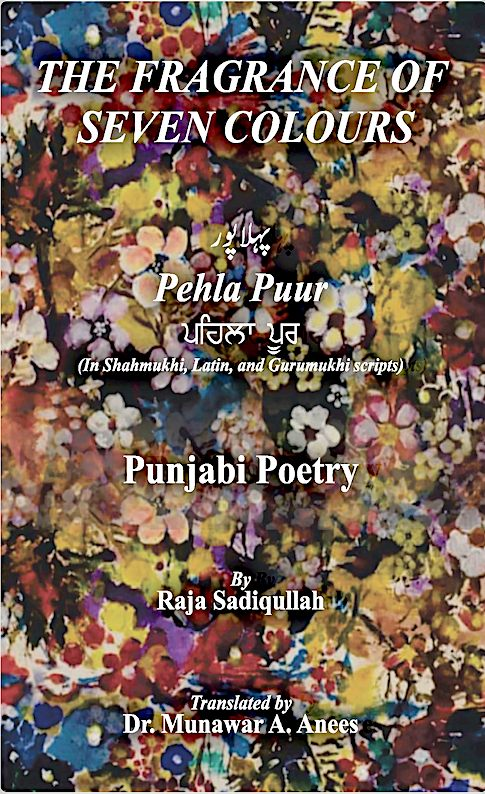
The Fragrance of Seven Colors
Arshad Raza
In contemporary Punjabi poetry, Raja Sadiq Ullah emerges as a poet whose creative practice is not confined to aesthetic pleasure alone; rather, it establishes a sustained dialogue with the reader on intellectual, cultural, and human planes. His poetry not only preserves the civilizational memory of rural Punjab but also articulates the inner turmoil of modern humanity, collective suffering, and fundamental existential questions. This essay offers a critical examination of his poetic collection The Fragrance of Seven Colors, with particular focus on its style, intellectual dimensions, and symbolic system.
The foundation of Raja Sadiq Ullah’s poetry rests on rural Punjabi life, local culture, and the inner vitality of the mother tongue. His poetic voice grows out of regional dialects, folk wisdom, and historical consciousness. This deep-rooted cultural connectedness prevents his work from remaining a mere expression of personal experience; instead, it elevates it to the level of collective consciousness. In his poetry, language is not simply a medium of expression but a symbol of identity, resistance, and cultural survival. His insistence on writing in the mother tongue effectively affirms the idea that the soul’s most authentic and non-imitative voice can fully manifest only in the language in which one’s cultural formation has taken place.
The poems in this collection are marked by gentleness, dignity, and layered meaning, resulting in a balanced and mature style. Raja Sadiq Ullah does not treat poetry as a mere verbal construct; he transforms it into a visual and sensory experience. Seasons, landscapes, and natural elements assume symbolic roles in his work. Water, mountains, birds, trees, and the rural atmosphere are not decorative motifs but active agents in the transmission of meaning. Consequently, imagery in his poetry becomes a reflection of inner states rather than an external description.
The very title of the collection, The Fragrance of Seven Colors, extends this symbolic system. Colors here are not simply aesthetic metaphors; they signify the multiplicity of human emotions, experiences, and inner conditions. On his poetic canvas, the poet weaves pain, hope, memory, seasons, and time in such a way that each poem evolves into a complete sensory experience.
A defining characteristic of Raja Sadiq Ullah’s poetry is its profound human empathy. The poem “Why Are We Here? (The Children of Gaza)” represents a deeply meaningful poetic response to a universal human tragedy. This poem is not a political statement alone; it is a dialogue with the collective conscience of humanity. The fear, insecurity, and existential questioning experienced by children are presented with such intensity that the reader does not remain a detached observer but becomes morally involved in the experience.
The poem “Paper Boats” stands as a representative work illustrating the tension between nature and the inner self. The search for the North Star, moonlight, and rain serve as metaphors for the clash between human perception and destiny. The paper boat drifting in a flood becomes a symbol of collective helplessness and limited possibilities. This expressive tension reaches its peak in the line:
Flight was never written in our fate.
This line poignantly captures the distance between human desire and predetermined destiny with striking simplicity and depth.
In poems dealing with personal and emotional relationships, the poet avoids romantic superficiality. Instead, he presents the fragility of relationships, the disintegration of friendships, and the loss of innocence in a realist manner. He arrives at the candid realization that deep and genuine pain often originates from first love, and that such experiences ultimately lead to the maturation of human consciousness. This acknowledgment engages the reader not only emotionally but also intellectually.
The poem “Saman Burj Wazirabad” is a symbolically rich text connected to the poet’s birthplace, where personal memory and collective history merge seamlessly. The grandeur of the past, social contradictions, inner desolation, and an inescapable sense of loneliness prevent the poem from becoming mere nostalgia; instead, it transforms into an existential inquiry. Here, place is not geography alone but a metaphor for identity itself.
Raja Sadiq Ullah possesses exceptional command over the Punjabi language. Words and expressions in his poetry are not mere lexical units but elements charged with semantic energy. Even complex and abstract ideas are shaped into poetic form in such a way that complexity does not become a burden; rather, it opens new dimensions of meaning. This stylistic balance grants his poetry a distinctive position in contemporary Punjabi literature.
In making this collection accessible to a global readership, the role of the translator, Dr. Munawar A. Anees, is of critical importance. His scholarly and intellectual background ensures that the translation transcends a purely linguistic exercise and becomes a genuine intercultural dialogue. The common assumption that poetry loses its essence in translation appears considerably weakened after engaging with this work. Dr. Munawar A. Anees has transferred the emotional resonance, symbolic structure, and cultural nuances of Punjabi poetry into English with integrity and creative sensitivity, preserving the spirit of the mother tongue while making the text effective for international readers.
Raja Sadiq Ullah’s poetry represents a creative consciousness in contemporary Punjabi literature that harmonizes nature, language, and human experience into a unified whole. The Fragrance of Seven Colors is not merely a poetry collection; it is an intellectual, cultural, and intuitive document that connects local experience with the universal human condition. It is this very quality that lends the collection enduring literary and critical significance.