Trained in the precise language of the law, Sandhu pivots to fiction to explore the unresolved, fragile testimonies of the human soul rather than seeking final judgments
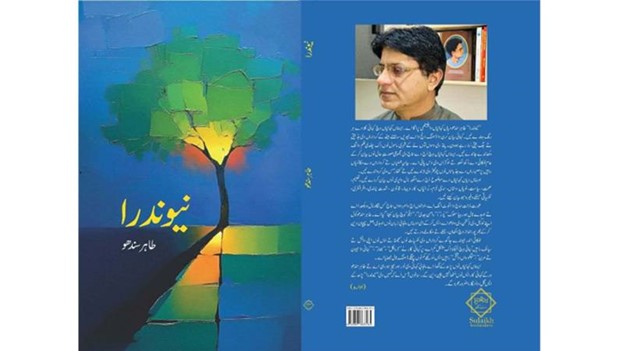
Some stories don’t begin on the page. They arise from silence – from the space between what is spoken and what is endured. Tahir Sandhu s’ Neondra his debut short story collection ,grows out of this silence where unexpressed pain gradually turns into sound and finally takes the shape of narrative. Trained as an advocate and familiar with precise language of law, Sandhu moves away from legal certainty in his fiction to explore unresolved human experiences. His stories don’t seek judgment or final answers, they bear witness to lives defined by endurance, making silence not an absence but a powerful source of meaning. His literary voice listens not to declarations but to the hushed and fragile testimonies of the human soul -those truths that survives in feelings long before they final words. Neondra reveals that Sandhu has been writing inwardly for years allowing his words to mature in silence before letting them emerge into light.
“hond ain ya unhond ma tainu choona chahna”
Sandhu ji doesn’t disappoint, his opening story “Udeek” (waiting) immediately wins the reader over. Through restrained symbolism he reflects on life ‘s unpredictability showing how it slips away when we try to hold it and how time and opportunity comfort us only when choices are made in time. When time moves too swiftly, hope gives away to regret and pain, raising a quiet but profound question. Is the human soul a prisoner of time ?
“Udeek” rests in the unresolved longing -for escape, for eternity -whilst confronting the irrevocable truth of time.
“Ja chala ja …bhar chukna tere wus da kam naee.”
Go—your hands are too unclean to bear the weight of this nation’s fate.
Sandhu’s collection Neondra is no nectar meant to soothe; it is bitter, austere, raw, and uncompromisingly real. Its power lies precisely in this harshness
Bhaar is the story of a pariah adrift in the indifferent sprawl of a metropolitan city, a man rendered invisible by crowds and concrete. Cast to the margins of human belonging, he finds his only mirror and witness in a stray dog—a silent protagonist whose loyalty speaks where language fails. Together, they navigate hunger, humiliation, fleeting warmth, and the quiet cruelty of urban lif
Sandhu does’t write ….he gives voice to a nation s’ silent despair. Through symbolism and piercing insight, he unravels seventy years of sufferings under the ruthless system, where the powerless endure and the rulers drain without mercy. The story carries the weight of collective anguish transforming the everyday struggles of a common people into a haunting meditation on oppression, endurance and the human spirit s’ quiet resilience.
Tale of a gravedigger and his wife, the latter tending to the dead—a grim tableau that masks a deeper symbolism. The “Bijo” do not dwell in graves; they inhabit human conduct, language, and the recesses of malevolent spirits, emerging at will—by night or by day, veiled or bare—drawn to the scent of blood, living or departed, to consume and corrupt. Yet, the narrative closes on a luminous note: for every harbinger of evil, there exists a resolute counterforce. In its denouement, hope endures, affirming the persistence of moral courage amidst pervasive darkness, evil doesn’t require darkness to exist it merely requires permission. Same as
William Golding makes explicit, “the monster lives among us because it is us.
Neondrais another piercing lament against ignorance sanctified as faith, where Tahir Sindhu challenges the coercive grip of rigid clericalism(mullah) across sectarian lines. Echoing the Sufi conscience of Bulleh Shah, Shah Hussain, and Baba Farid, the narrative affirms spirituality as service to the marginalized and resistance to entrenched power, transforming the story into a quiet yet radical call for moral awakening and human dignity.
Sindhu’s Kahni da Jewn Mern is a sharp satirical meditation on a society that compels its people to live like the dead. With piercing, lyrical brevity, the story reveals how many sufferings are neither chosen nor deserved, yet are forcibly endured as social fate. It captures the haunting paradox of survival—the unconventional realism interrogates truth that has been swept under the carpet.
The tragedy of 1947 carved deep wounds in Punjab, severing land with blood while leaving hearts intertwined. Sandhu’s Ramn Jadi speaks of this silent, unspoken sorrow—pain that neither death nor life can soothe. The Partition rendered the land barren, a testament that hearts cannot be conquered by force; they remain infertile, carrying grief that no soil, no bloodshed, can ever erase,Such pain neither allow death nor life, the land of Punjab could not be flourished again that is the biggest tragedy of the century had ever been.
“Faisla” is yet another outstanding narrative by Tahir Sandhu—a writer singularly capable of laying bare the naked and unsettling truths of a society suffocating under the fractured shadow of its own legal and moral order. His fiction does not merely portray oppression; it indicates a system where law itself stands divided, rendering the weak voiceless and the marginalized perpetually helpless.
Tahir Sandhu’s Neondra, a collection of thirteen short stories, is both intellectually engaging and socially insightful. As a committed native writer, Sandhu reflects a deep attachment to his land while critically addressing its core social concerns. Although a detailed discussion of all the stories is not possible here, “Jugnu ka Qafla” and “Bhagiree” stand out for their thematic depth and literary merit, commendable reading.
Sandhu’s collection Neondra is no nectar meant to soothe; it is bitter, austere, raw, and uncompromisingly real. Its power lies precisely in this harshness. The text confronts readers with an unvarnished reality and urges them to abandon the comfort of silence—to write truthfully, to move forward without fear, to refuse the cowardice of denial, and to raise their voices boldly against injustice. Sandhu positions literature as resistance, transforming his stories into a collective outcry for the oppressed and dispossessed.
These narratives function as a sustained protest against a decaying social order rooted in injustice, oppression, and psychological enslavement—an ignorance perpetuated, in particular, by rigid clerical dogmatism. The blind followers of Shah-bahadur from centuries past have not vanished; they persist in new guises, wielding authority without wisdom. Sandhu exposes this continuity with remarkable courage and clarity.
Artistically, Sandhu weaves his stories with the precision of a master painter, crafting his own brush and colors before shaping the final image, or like a filmmaker orchestrating diverse characters to construct a compelling cinematic vision. His use of metaphor, incisive irony, and satirical nuance—combined with a flexible tonal range and mature narrative control—demonstrates exceptional craftsmanship.
He has also transliterated the poetry of Amrita Pritam and Shiv Kumar Batalvi from Gurmukhi into Shahmukhi. In his stories, one can glimpse his deep affection for both poets—the haunting rhythm of Shiv and the unflinching realism of Amrita—quietly interwoven into his own narrative voice.
Neondra is intellectually stimulating, socially urgent, and far from monotonous. It challenges, unsettles, and awakens. Tahir Sandhu deserves sincere congratulations for producing a work that is not only informative and thought-provoking but also a courageous literary intervention against silence and submission.The collection is highly recommended for readers seeking thought and meaning literature.
APNA
Articles
Writing Inwardly: How Silence Matured Into Tahir Sandhu’s Neondra
← Previous Article