M.S Gill
M S Gill, former Chief Election Commissioner of India and a member of the Rajiah Sabah experienced much that was different and a lot that was the same on this side of the Punjab
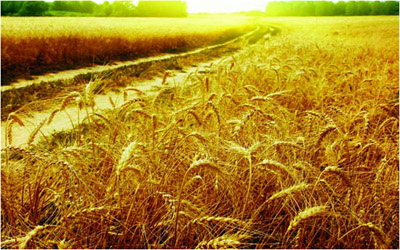
Compared to India, Pakistan’s wheat procurement system is primitive
I was born in Aldinpur village of Amritsar ten miles from the border with Pakistan. Lahore and Amritsar are the heart of the old Punjab. Prime Minister Nawaz Sharif’s original village, Jati Umra, is five miles from mine. The two Punjabs are embedded in two countries, but it cannot be forgotten, that in history and culture, they are one people: same language, same food, same dress, same ceremonies, and the same swear words and jokes.
Dr. Syed Babar Ali, is the Founder and Chancellor, of the Lahore University of Management Sciences, justly famous in Pakistan. Dr. Iqrar Ahmad Khan, an acclaimed agricultural scientist is the Vice-Chancellor of the Faisalabad Agriculture University. Both had been pressing me for long to visit them and speak to their students. In the last week of March my wife and I finally decided to go.
We crossed the new Attari Border. The process there is tedious and slow, and not conducive to expanding visitor’s numbers or trade. The trade trucks choke up the main road and there is utter confusion. There is an obvious need to park the trucks in a separate designated area, away from the road to Lahore. The Pakistani processing on the other side, is easier and faster.
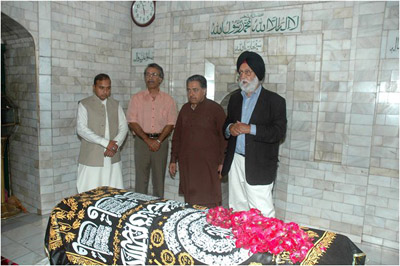
The author at Baba Farid’s shrine
At Wagah Border, I was surprised to be asked to take polio drops. I thought: these should have been given to me in my childhood. I know the reason now. But I would appeal to the people of Pakistan to give the polio drops to their children for their health and well-being. In India, there is no polio now. I was given polio drops to ensure I did not bring the disease back from Pakistan.
In our country security guards have become a means to elevate a politician’s status
We stayed at the Lahore Gymkhana where we did not have any security guards, nor have I ever felt the need for any, here or there. In our country security guards have become a means to elevate a politician’s status. They cannot protect him, hemmed in, as they are, by crowds pressing in. Anyone watching TV can observe that the guards are a futile waste, and could be better used in giving protection to all citizens.
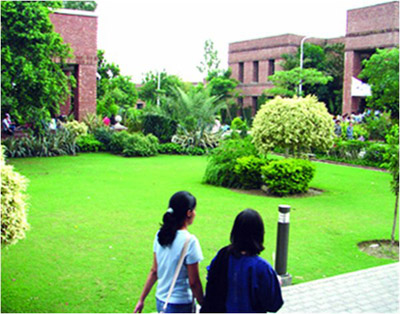
‘Boys and girls talk to each other as they would at Delhi University’
In the afternoon I went to LUMS and spoke to a big gathering of students and staff from many faculties. The Vice-Chancellor and Dr. Syed Babar Ali – incidentally a school friend of our former Chief Minister Harcharan Singh Brar – were present. They were most curious about our election system, electronic voting, and the whole process of democracy that was going on in India. I noted with interest that boys and girls were present in equal numbers and they questioned me intensively. They want to learn more about India. I asked to be taken to the canteen for tea and observed boys and girls sitting in happy groups. I was also taken around the university; classes had ended and students were all gathered in an open courtyard. Boys and girls were talking to each other as they might in Delhi University, in easy camaraderie. The images of Pakistan people promote here are not correct. They have their loony bins, as we have ours. Like us, the large mass of people have a lot of good sense.
The officers sitting around and listening were shocked at my remarks
The next day I went to see Mian Shahbaz Sharif, the Chief Minister. He had invited me. He was fascinated with our talk on development, and my explanations of the Punjab system of minimum support prices, full procurement of wheat and paddy, and prompt payments in 1500 regulated Mandi Board market yards. I laughingly said to him that our wheat would be procured after the 13th of April, and the entire Cabinet with the Chief Minister would travel to market yards to ensure farmer satisfaction. In my Punjab, I said democracy gets rid of chief ministers who fail in this prime duty! The officers sitting around and listening, were shocked at my remarks. The CM took them well. Pakistan has no such system. I saw later in driving around Sahiwal and Faisalabad districts that out of 20 million tonnes wheat coming in, they were going to buy only about 3 million, that too, from big influential farmers. I saw no godowns. In one place only, I saw a small stack under tarpaulins, on the ground, not even on plinths. The CM had recently been to our Punjab, but the time was spent in great political hospitality. No one was there to explain to him how we do things. He was fascinated and continued the conversation for long. When I left, he urged me to keep in touch. I suppose he does not ever get my kind of irreverent views. After I came back to Delhi, friends rang me to say that the CM had taken full note of what I said and directed his Cabinet to move out to the districts to ensure
service