Hira Azmat
Along with taking a dozen pictures for Vikram Seth fangirls and soaking in the general vibe of the place, Hira Azmat went to the halls less populated at the LLF
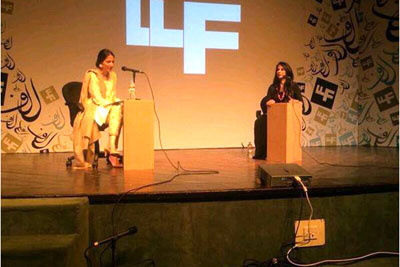
Shehrbano Taseer in coversation with Shobha De
The most exciting part of any Literature festival is the speaker line-up, obviously because it adds to the quality of the sessions, but also because it gives us – the plebeians – a chance to be in the general vicinity of literary stalwarts. The thrill of running into them in say, the queue for the loo, or while wolfing down the pathooray on offer, makes the whole thing quite exciting. And the Lahore Literary Festival did not disappoint in this regard, with arguably the most star-studded line-up for a local litfest thus far, including Indian star novelist and poet Vikram Seth, American academic and author Vali Nasr, gossip columnist and novelist Shobha De, filmmaker Mira Nair, and the first local public appearance of one of our most internationally acclaimed artists Shahzia Sikandar in many years
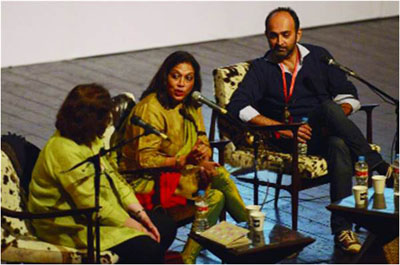
Mira Nair and Mohsin Hamid Photo by Saad Sarfraz Sheikh
Unfortunately, my celebrity stalking skills left much to be desired, and the closest I came to a celebrity encounter was getting roped in to take about a dozen photos for random fangirls with Seth, who kindly said “Well, hello” to me afterwards, leading me to subsequently gush and stammer. I also hovered awkwardly around novelist Mohammed Hanif, whose Our Lady of Alice Bhatti holds its place in my heart as the most brutal and compelling Pakistani novel in English to date, while he grappled with a samosa swimming in chana. There’s always next year, I suppose. In general, it was quite heart-warming to see women giggling and squealing over short, balding men for a change, and young men dumbstruck and stumbling around middle aged women (on day 2, an awed 20-something male friend parked himself in front of Mira Nair, mumbled “Hello, I love you” and presented notebook for signing purposes).
Shobha De called Lahore”the scandalous, tempting mistress” and Karachi “the boring wife”
This time, I’d vowed to avoid any session that was about international relations or contained the word “global” in its title (trust Pakistanis to drag politics and Larger Global Implications into any space), and focus instead on literature as one should at a literature festival. Unfortunately though, this meant I missed Jugnu Mohsin’s session on ‘The Making of Political Satire’, hilarious and one of the highlights of the festival, by all accounts. But assiduously avoiding these buzzwords gave me a chance to often avoid the most impersonal and jam-packed sessions, and attend the smaller, more intimate discussions.
Panellists discussed the singling out of female authors for scrutiny that their male counterparts aren’t subject to