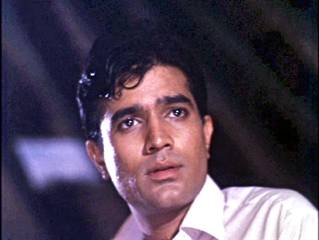
Bombayaa films’ original superstar Rajesh Khanna, who has died aged 69, was the man who sparked a frenzy never seen before and never since, not even by the likes of Amitabh Bachchan.
In his four-decade career, he appeared in about 160 films; of which 106 had him as the solo lead hero and 22 were two-hero projects.
Khanna had a small beginning in Amritsar. Born Jatin Arora in 1942, he was adopted and raised in Delhi by foster parents Chuni Lal Khanna and his wife Leela Devi. They were relatives of his biological parents.
In a congested neighbourhood of Amritsar’s walled city Gali TiwarhiãN, the place where the family of Khanna lived is now a temple. He had donated the house and a temple was constructed several years ago.
“He used to love to play cricket when he lived here. He was a simple boy and led a simple life even after achieving so much,” Khanna’s foster brother Muni Chand Khanna said.
He went from being Jatin to Rajesh, thanks to his uncle who changed his name, when he decided to join films. In 1965, the journey to filmdom started after he won the All India Talent Contest organised by United Producers and Filmfare. He made his debut with Aakhri Khat in 1966. “We spent three days in a gurudwara when we reached Bombay. Those were hard times,” said Khanna’s friend Satish Khanna, who also tried his luck in the film industry.
In the 1970s he starred in super hits like Safar, Kati Patang, Sachã Jhutha, Aan Milo Sajna, Anand, Amar Prem and Mere Jeevan Saathi.
Kaka, as he was popularly known, was one of the highest paid actors of his time, his record of consecutive solo super hits still unbroken. Glory and fame galore came his way with the two super hit 1969 films – Aradhana and Do Rãste – where he teamed up with two of his best co-stars, Sharmila Tagore and Mumtaz, respectively.
His very name spelt magic in the 1970s. He sparked hysteria, particularly amongst his legions of female fans, who would line the road for a glimpse, chant his name, cover his car with lipstick marks and even write him letters in blood. They got married to his photograph, cut their finger, let the blood flow and applied sindhoor, as Sharmila Tagore recalls.
It was all about charisma – a certain something that went beyond the art of acting. He had that unique way of delivering a dialogue, of crinkling his eyes and that interesting head tilt that were all his own – and designed to get fans swooning.
Describing the charm of Khanna, Amitabh Bachchan once said: “I got famous purely because I was working with Rajesh Khanna in Anand. People asked me questions like, ‘How is he to look at? What does he do?'”
Rajesh proved his mettle in offbeat ‘parallel’ or smãnantar films too. He teamed up with Hrishikesh Mukherjee for the critically acclaimed Bawarchi and Namak Harãm. The quintessential romantic also did the intense Avishkãr, directed by Basu Bhattacharya.
But then age caught up and the star began fading away.
He moved to television and played the main lead in some serials. The decline to B-grade films was inevitable.
He dabbled in politics, being Congress MP from the New Delhi constituency from 1991-1996. In a BBC Hindi interview recorded in 1989 he showed his naive idealism that the political crisis [exacerbated by the state and khalistani terror] in East Punjab had prompted him to join the Congress party with ‘deep faith, honesty and love’, which in his opinion was a natural progression of his family tradition.
Sadly no Punjabi film director or producer ever approached him to work in a Punjabi film. One wonders – do super stars like Rajesh Khanna leave a legacy behind apart from having light entertained a generation of filmgoers? Perhaps Khanna’s two films Anand (1971) and Avishkãr (1974) will be remembered for years to come as classics of post-Pyasa era