by Pritam Singh
This write-up, based on distinguished Punjabi writer and teacher Professor Pritam Singh’s key-note address to the Fourth Punjabi Conference held in Delhi in 1993, was first published in Sirnawan (June 1993) and Watan (October-December 2010).
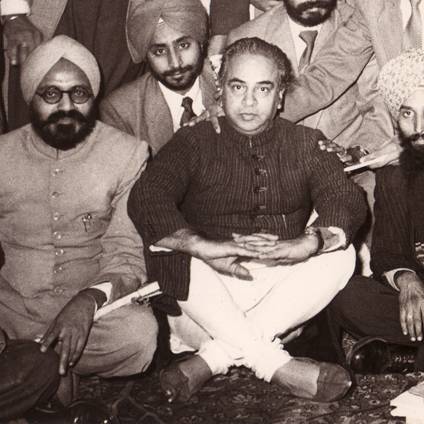
Great Punjabis. Pritam Singh (d. 2008) and Mulk Raj Anand (d. 2004).
Afro-Asian Writers Meet. New Delhi Dec 1956.
© Photo Amarjit Chandan Collection
An important task that I wish to assign to this Conference concerns some words which will be bandied about frequently from the stage and which have already become current in the Punjabi world. The semantic boundaries of these words are still indeterminate and there is a need to bring to an end this indeterminacy so that we can be certain about their meanings and everyone knows where the Conference stands in regard to its basic concepts. There are many other words also whose semantic boundaries need to be fixed, but today I’ll take up three words only; these are “ Punjab ”, “Punjabi” and “Punjabiyat”. My suggestion is that the help of eminent scholars should be sought to determine the semantic zones of these words.
I am attaching priority to this task because in the future the connotations of these words will define the scope of the Conference.
For instance, let us first consider the word “ Punjab ”. I had an opportunity to stay in Pakistan for about ten or eleven days in 1989. One day, while enjoying a cup of tea at a friend’s in Lahore I asked his daughter who was a sixth standard student, “My child, are you a Sindhi or a Balochi?”
She laughed and replied, “No uncle, we’re Punjabis.”
I again asked: “Do you know the geography of the Punjab ?”
She answered: “Yes I’ve.”
I said: “Would you tell me where Punjab begins and up to which place does it extend?”
The girl answered with alacrity: “The Punjab province extends from the Sindh and NWFP right up to the Lahore border.”
The same question I put to my grandson after I came back. He too incidentally happened to be a sixth standard student in Amritsar . His answer was, “It is all Punjab from Wagha border to Shambhu barrier.” As you all know, when you enter Haryana from Rajpura, Shambhu is the last village of Punjab bordering Haryana.
These answers make it clear that whenever the talk of Punjab begins in front children from Lahore and Amritsar , two different maps of Punjab , both different from actual reality, appear in their minds. We all know that this is true not only of children from Lahore and Amritsar , rather for millions of people in Pakistan , Punjab means what it meant to the young girl from Lahore and for millions of Indians, the meanings of the word Punjab are the same as were given by the boy from Amritsar .
The second World Punjabi Conference was held in Lahore from 26 to 29 December, 1992. It was a World Conference. The question that now arises is if this World Conference held in Pakistan should adopt the official map of Punjab issued by the Govt. of Pakistan or not? And whether our World Punjabi Conference should, without showing any resistance, adopt that map of Punjab which has been issued by the Indian Govt.?
The answer to this question will determine what this Conference and the one held in Pakistan will do and for whom.
But the issue will not be resolved by these two maps alone because whenever scholars sit and decide the semantic boundaries of these words, as I’ve appealed, they’ll have to confront many more maps. You all know that the political and administrative boundaries of Punjab have changed considerably on many occasions. Even if we do not talk about the Iranian or Greek occupation of the western part of Punjab, and in the same manner, even if we ignore the altered Punjab boundaries in the period beginning with Mehmood Ghaznavi up to Ahmed Shah Abdali, and we start from the times of Maharaja Ranjit Singh, even then there is this apprehension that the number of maps will be quite large. During the Maharaja’s reign, Jammu and Kashmir , Himachal and the NWFP (which is in Pakistan now) had become a part of Punjab . And then during the British colonial rule, Punjab remained a part of the vast North-West administrative unit which extended up to Agra . Will the World Punjabi Conference be prepared to accept the map of a multi-lingual and multi-national Punjab of Maharaja Ranjit Singh’s period or that of the British period?
The final decision I would like to leave to the specialists but I will not deprive you of my opinion. If your scholars think it prudent, they may consider my view, otherwise it is up to them and you.
My view is that while trying to draw the right map of Punjab the World Punjabi Conference, which is not a political organisation according to its own declaration, should step out of the erstwhile political and administrative enclosures and try to make culture and language the basis of the new map. The lines of the map drawn in such a manner will go beyond the boundaries of many states of at least two nations. It does not matter to me nor should it matter to the Conference, whether any country, province or political party accepts or rejects this concept of Punjab because my policy is to accept the honest findings of the linguists and scholars of culture and not to extend forcibly the borders of the Punjabi speaking areas. It is natural that I ask the World Conference to do a similar thing. Whatever be the present boundaries, the real homes of the Punjabi-speaking people and the boundaries of Punjab will be drawn for the first time on this
new map.
Like that of “ Punjab ” the meanings of the word “Punjabi” also are not uncontested. If the map of Punjab is to be drawn by ignoring linguistic and cultural aspects and under purely political and religious considerations, then believe me, these very considerations will come into play at the time of fixing the semantic zones of the word “Punjabi” which denotes language. If you do not believe what I say, then listen to what an admirer of the Pakistani writer Mushtaq Basit’s book Pak Punjabi says while summarising the book:
After a thorough comparison of Punjabi from across the border with Pak Punjabi, Basit Sahib has reached the conclusion that the cultural and literary fount of Pakistani Punjab is Arabic and Persian. The literary heritage of Pakistan begins with the writings of Waris Shah, Bulle Shah, Mian Mohammad Bux, Sultan Bahu and other Sufis. In our Punjabi slokás and bhajans are neither recited nor heard.
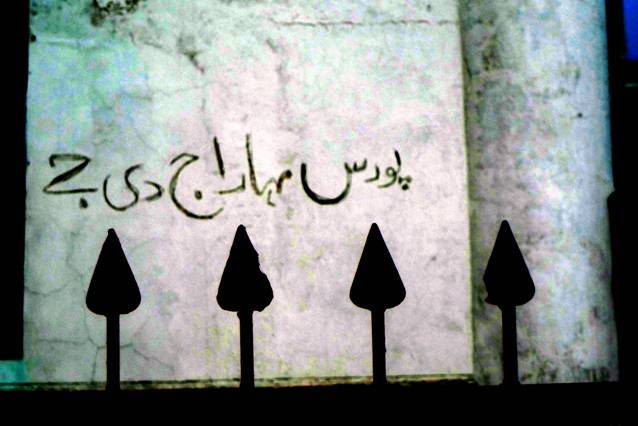
Maharaj Porus dee jai. (In eternal memory of Porus the King of the Punjab ) Graffitti on the shameful memorial to Alexander the ‘Great’. Jalaalpur Sharif. West Punjab . December 2009
© photo by Amarjit Chandan
Basit’s book is a beautiful example of how a lover of Punjabi, dyed in the hues of religion and politics uses Punjabi language for nationalistic purposes by giving it the colours of his politics and religion. Basit Sahib is a well wisher of Punjabi, he wants development of Punjabi but he has such firm faith in the concept of purity and impurity that if, even inadvertently, his Pakistani Punjabi were to come into contact with the Indian Punjabi, then to him the entire Pak Punjabi would become impure.[1] Obviously, the proclivity of a person who recognizes Islamic-Pakistani Punjabi as the only Punjabi is born out of his deep but warped love of Pakistani Islamic Punjabi.
A quasi-political and quasi-cultural movement in the name of “Sarayki language” has been going on against Pakistani Punjabis. The proponents of Sarayki claim that this dialect of Multan-Bahawalpur is a separate language and on this basis, they are asking for a new Sarayki province. Like the Sindhis, the anger of the advocates of Sarayki is directed more against Punjabi than against Urdu. Deeming Sarayki to be a dialect of Punjabi, the scholars of Punjabi in Pakistan oppose a separate status for Sarayki.
In this part of Punjab also, almost a similar situation prevails. Punjabi scholars deem the languages of Kangra and Jammu to be dialects of Punjabi, but some political leaders of these areas consider Dogri language and Pahari culture to be essentially different from Punjabi language and culture. They have embraced Hindi, and considering Punjabi to be untouchable, cannot bear to have it even at their doorsteps where they keep their shoes.
As it is, even from a purely linguistic angle unhampered by any politico-religious considerations, there are several viewpoints about Punjabi language. This is exemplified by how Mohan Singh Diwana and Igor Dmitriyev Serebriakov consider literature written by Punjabis in Hindi, Urdu and even English to be Punjabi literature. Perhaps for them, Punjabi literature means literature written in Punjab . In his first speech made after taking over as Professor of Punjabi in Delhi University , Harbhajan Singh, like Mohan Singh Oberoi Diwana, had advocated enlarging the sphere of Punjabi. And in my Preface to a 1990 Punjab University publication Selected Medieval Punjabi Poetry, I took a position which is close to this. But contrary to this view, many Punjabi writers, starting with Late ‘Prof.’ Teja Singh, consider Punjabi spoken in Lahore and Amritsar and various other dialects spoken in Punjab as part of Punjabi language, but do not consider literature composed in Hindvi, Bagri, Sadhukri, Hindi and Urdu as Punjabi literature.
You all know that the basic grammatical structure of Punjabi and Urdu is the same. But since Hindi, in the manner of a beggar, makes a mendicant’s call at the doorstep of Sanskrit when it has to coin new words, and the practitioners of Urdu generally borrow their words from Arabic and Persian word-smithies, two different language styles have gradually emerged as two separate, independent languages; more so because these two have different scripts. Some Pakistani scholars cast in Basit Sahib’s mould, making an example of the breach between Hindi and Urdu, are bent upon creating hurdles in the way of affinity between Pakistani Punjabi and Hindustani Punjabi. However, on both sides of the border, there are people who, by quickly repairing this breach, do not want these two languages to become independent languages. I belong to this group.
Given such a linguistic scenario, the World Conference, whenever it employs the word “Punjabi”, will have to decide what it means by it.
While taking a decision, it will have to be kept in mind that Punjabi is one of the largest languages of the world. It is said that the number of speakers of Punjabi has crossed sixty million. On the basis of this number, it ranks eleventh or perhaps twelfth in the world. Hence, it is no disgrace that Punjabi has a large number of dialects. If this trend is accepted, then there will be a need to make some adjustments in the continuously expanding frontiers of Punjabi language. Owing to increasing means of collaboration between speakers of different Punjabi dialects and also because of growing practice of written literature, a standard Punjabi has emerged and is getting stronger by the day.
Mushtaq Basit’s parochial concept of “ Punjab ” does suggest such a narrow and provincial concept of “Punjabi”, but what is happening in actual practice implies that:
Having given up their love of Arabic-Persian words, many writers on this side of Punjab have just about agreed to take refuge in Hindi-Sanskrit. A majority of writers belonging to older generations considers this a sign of contemporary Punjabi writers’ apathy and servitude to the prevailing linguistic environment. But the present generation is not troubled by any such qualms.
- Just as some writers from the West Punjab knowingly boycott Punjabi writers from this side in their articles and research papers, writers from the East Punjab do not do exactly like that, but they generally make references to Punjabi writers from the East Punjab only and do not evaluate new Punjabi writers from the West Punjab.
- The way Mushtaq Basit has given Islamic tinge to Punjabi, the Punjabi of several East Punjabi writers is dyed in the Sikh colours.