FIRST HALF OF THE LIFE OF LEGENDRY FILM SINGER MOHAMMAD RAFI
Harjap Singh Aujla
MOHAMMAD RAFI’S EARLY YEARS IN AN UNKNOWN VILLAGE IN RURAL AMRITSAR
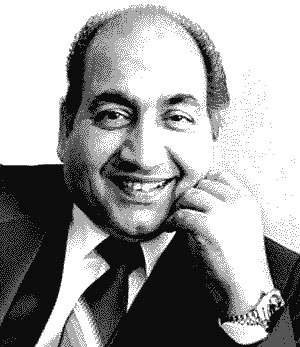 Punjab must be genuinely proud of its great son Mohammad Rafi, who was born in a non-descript hamlet in a remote rural area of Amritsar district. Starting from a humble and modest beginning, he rose to become the most prolific film playback singer of the movie industry, not only in India , but in the whole world.
The Punjabis should be doubly proud that two of their sons have ruled over film singing for more than half a century. K.L. Saigal was the first Punjabi singing star, who dominated the Indian film industry for a decade and a half from 1933 to 1947. The Indian film industry switched over from silent movies to talkies in 1931, when film “Alam Ara” was made. But ever since actor singer Kundan Lal Saigal started his film career in the eastern metropolis of Calcutta in 1933, he did not look back and went from strength to strength, until death put a sudden end to his brilliant career as a singing leading actor in the dark year of 1947.
When Saigal’s health was deteriorating, Mohammad Rafi was warming up to step into Saigal’s spikes. Mohammad Rafi’s success story is indeed a story of rags to riches. He was born in a village called “Kotla Sultan Singh” near the town of Majitha in the then Punjab ’s second largest district of Amritsar. Most of the land in his village was owned by Sikh farmers and the Muslim families were assisting them. The relations between the two communities were extremely cordial and the village was a happy community, unaffected by what was happening in Lahore and Amritsar . Most of the inhabitants had very few desires and aspirations and that precisely led to their contented lifestyle. The children of the village used to play “Chhattapoo”, “Pithoo”, “Kokla Chhapaki” “Gulel and target” as well as hide and seek. Mohammad Rafi’s childhood was not much different from other kids. In addition Mohammad Rafi liked to copy the folk singers in his amateur way.
Mohammad Rafi was always falling in line with most of his villager folks. His education was confined basically to reading and writing in Urdu in Persian script. Cramming up of a little bit of multiplication tables was his other education. In his moments of leisure, he used to carry his family’s and friends’ cattle for grazing in the fields. Intensive cultivation was alien to most of the villagers then and a lot of grassy fields were left untilled for the cattle to graze. As a child Mohammad Rafi always loved to graze cattle. He had heard some local “Mirasis” (Muslims, who’s profession was singing and acting as folk comedians) singing folk songs in semi-classical and other country tunes. He liked this art and his voice was suitable for it. He used to copy the “Mirasis” of his surrounding villages. While grazing cattle he used to sing popular Punjabi folk songs to all and sundry in the village.
Mohammad Rafi was born in 1924 in his ancestral village Kotla Sultan Singh. Radio during those days was in its infancy in Europe and America . India did get some experimental radio in the four metros of Calcutta , Bombay , Madras and New Delhi in 1927. Lahore had a brief stint with amateur radio in 1928. But organized broadcasting came to Punjab in 1936 in the public sector. The newly constructed studio complex opened in Lahore in 1937. Thus up to the age of thirteen, Mohammad Rafi had practically no exposure to radio.
Gramophone (in America phonograph) was already in great demand in the high-end “Bazaars” in the commercial city of Amritsar . Most of the wealthy people had already bought gramophones for their homes. Mohammad Rafi had also heard some music in the “Havelis” (imposing houses of the rich in Punjab ) of Majitha and the Bazaars of Amritsar. Born in Amritsar Indu Bala, was the then leading most “Thumri” singer of India and Kamla Jharia was fast becoming the most prolific “Thumri” and “Ghazal” singer of India. These voices could be heard during those days in the music stores of “Hall Bazaar” in Amritsar . Mohammad Rafi certainly had some exposure to this music. His once in a blue moon visits to the historic “Hall Bazaar” always left behind sweet memories. Bhai Chhaila of Patiala was the most popular Punjabi folk singer of that time and Dina Qawwal of Jalandhar was becoming popular. Both these artists had some impact on Rafi. Agha Faiz of Amritsar was a great gramophone singer. Rafi had heard all these voices. Nevertheless he was happy and blissful in the dusty fields of his village. Every one in the village was his friend and none was his foe. What a life he had?
There was no one in his village to initiate Mohammad Rafi into the intricacies of classical music, which was and still is the mother of all music in India . Unaware of his handicap of not learning classical music, Mohammad Rafi kept singing to himself and to his simple village folks. His father wanted to create better living conditions for his family. One fine morning his father decided to leave for Lahore the capital of Punjab about fifty miles away from their village. Like several other Amritsaris, he was a very good cook and Amritsari cooks were in great demand not only in Lahore , but all over Northern India . His father opened a “Dhaba” (a no frills country style eating house) in Lahore . His food was invariably delicious and the customers both locals and outsiders started thronging to it. Well begun is half done, he sent a massage to his son Mohammad Rafi to come over to Lahore . Mohammad Rafi reached Lahore round about in 1941, at the age of seventeen.
His father got Mohammad Rafi a job at a hair-dresser’s saloon. He used to shave the customers’ beards quite slowly but carefully. In order to keep his customers in good humour, while doing cuttings and shavings he used to keep singing some folk and country songs of Punjab . Rafi’s customers seldom took notice of his slowness, rather they enjoyed his music. One day Jiwan Lal Mattoo, the program executive of music at All India Radio Lahore passed by the hair cutting saloon and he faintly heard young Mohammad Rafi’s enchanting voice and he instantly liked its sweetness, range and tonal quality. He stopped and paused for a while and then entered the shop. He asked Mohammad Rafi if he was interested in becoming a radio singer. On hearing this unsolicited offer, Mohammad Rafi jumped in the air in happiness. In the month of March in 1943, Mohammad Rafi appeared in the audition test at the studios of All India Radio Lahore and to his utter surprise he passed the test. Thus from March 1943, Mohammad Rafi became a radio artist. This happened six months prior to the Nightingale of Punjab Surinder Kaur becoming a radio singer. At about the same time in 1943, after hearing his voice on the radio, a newly emerging film music director Shyam Sunder requested Mohammad Rafi to sing a song for his Punjabi film “Gul Baloch”. Mohammad Rafi did full justice to this film song and it opened the gates for his future entry into the field of Bombay ’s playback singing.
MOHAMMAD RAFI’S UNEVENTFUL HALF DECADE IN LAHORE
Mohammad Rafi, a genius who rose to be the leading most film singer of the Indian subcontinent, had a modest and uneventful beginning. At the time of his arrival in Punjab ’s capital city of Lahore , from a small village of neighbouring Amritsar district, Mohammad Rafi had absolutely no idea or for that matter no expectation that some day he can be the leading film playback singer of his time. He was a saintly figure since childhood and was contented with his destiny. .
Prior to moving to Lahore , he was married to the daughter of an uncle. Those were the days when child marriages were not uncommon in Northern India . He was less than fifteen when he entered into the wedlock, but he was told by his father-in-law to become self supporting before his wife could join him.
For a couple of years, he was shaving the beards and cutting and dressing the hair of Lahorias. He kept enjoying even this profession thoroughly. He was not earning much money, but whatever he earned was more than enough to keep his soul satisfied and happy. Being a God fearing and honest young man, he had unique patience and bliss to live in whatever condition God desired him to exist. He never aspired to hop from one job to the other for better emoluments. Nature had blessed him with an uncanny unselfishness and utmost satisfaction in life. He never hankered after ill gotten wealth, power and pelf. Light music sprang naturally from his throat and he kept singing for his own pleasure and for the happiness of his customers. But his listeners saw something extraordinary in his sweet, melodious and soul inspiring voice. He was a God fearing person and a regular five times a day “Namazi”, but he was not the least bigoted. He could endear himself to any person who came in his contact even for a short-while.
Jiwan Lal Mattoo of the music department of All India Radio Lahore spotted his musical talent in 1943 and after rigorous audition process, he trained Mohammad Rafi to develop into a folk and country singer. The knowledge, practice and appropriate application of classical music is essential for any singer. Jiwan Lal Mattoo imparted the requisite knowledge of the most commonly used classical Raagas in Punjab ’s folk music to Mohammad Rafi. Raga Pahadi was one such raga and Bhairavi was another. Basant and Malhar were some other commonly used ragas in Punjab . In addition to Jiwan Lal Mattoo, Master Inayat Hussain also gave Mohammad Rafi the finer point of folk singing. Mohammad Rafi also got along very well with another music teacher Budh Singh Taan, who also groomed Parkash Kaur and Surinder Kaur. Incidentally both Parkash Kaur and Surinder Kaur were making more money while in Lahore compared to Rafi.
There were several known “Ustad” singers living in Lahore , who in age and years of experience were far more senior to Mohammad Rafi. He never tried to step on their shoes. Budh Singh Taan was also a light singer. Deen Mohammad used to sing as a solo folk singer, in addition to being a leading Qawaal. Agha Faiz of Amritsar was a very sophisticated folk and semi-classical singer. Another product of Amritsar , Shamshad Begum was senior to Mohammad Rafi by six years and born in Kasur child prodigy Noorjehan preceded Mohammad Rafi by four years. Both Umrao-Zia-Begum and Zeenat Begum were also senior to Mohammad Rafi. True to his quality of utter humility, Mohammad Rafi gave a lot of respect to all his seniors in profession. Mohammad Rafi was indeed a great learner. He won’t mind touching the feet of any “Ustad”, who was willing to teach him something new in music. That is why, “Ustad” maestros like Dilip Chander Vedi, a leading Dhrupad exponent of Punjab held Mohammad Rafi in high esteem.
Mohammad Rafi had a lot of regards for Bhai Samund Singh ji of Sri Nankana Sahib and a colleague at All India Radio Lahore. Once he said Bhai Samund Singh is so much at home with classical music that he talks in classical music, which we can’t. About Bhai Santa Singh, he used to say “Bhai Santa Singh’s high-pitched calls to the “Guru” can never go unheard. On Bhai Santa Singh’s 1966 visit to Bombay, Mohammad Rafi made it a point to attend each one of his renditions scheduled at various Gurdwaras in the city Similarly when block-buster Punjabi film “Nanak Naam Jahaz Hai” was made in 1969, both Mohammad Rafi and Bhai Samund Singh were its leading singers.
After Mohammad Rafi’s tough nut father-in-law discovered that his son-in-law has become a radio singer, he sent his daughter to join Mohammad Rafi. The couple was very simple, unassuming and very hospitable. Mohammad Rafi had a vast circle of friends and fans. They used to converge to his home to listen to his silken voice. Mohammad Rafi’s wife was never tired of being the hostess. Most Lahorias were fond of drinking, but Rafi had never touched hard liquor in life. His guests also respected his pious restraints and never insisted to drinking in his and his wife’s presence. His music was enough of an intoxicant to his friends.
Several movies in Hindi and Punjabi were made in Lahore during Mohammad Rafi’s stay in that city, but somehow it did not occur to any of the music directors to feature his velvety voice in a song. The only exception was another genius maestro Shyam Sunder, who gave Mohammad Rafi a Punjabi song to record. This film was “Gul Baloch” made in 1943. However this Punjabi film was poorly made and was not going to be a hit and its songs also sank along with the film.
A great music director Pandit Amar Nath liked Mohammad Rafi’s voice, but he had lined up other singers for his songs. Another great music director Master Ghulam Haider liked him too, but he was moving to Bombay . While packing up to leave for Bombay , he whispered in the ears of Mohammad Rafi to join him later on in Bombay . Ghulam Haider left for Bombay in the end of 1943. In his long and wide entourage were included his well known orchestra as well as Lahore ’s famous film singers like Shamshad Begum, Umrao-Zia-Begum and Noorjehan.
On a second call from Master Ghulam Haider, Mohammad Rafi decided to move lock stock and barrel from Lahore to Bombay in 1945. All that he used to earn was mostly spent on entertaining his friends and fans. It should not come as a surprise that Mohammad Rafi had not enough money to buy tickets in economy class for the Frontier Mail to Bombay . On this occasion his long term pampered friends and relatives, including his elder brother, came to his rescue. After an emotional and tearful send off at Lahore Junction, he dis-embarked in Bombay after two days of monotonous train journey. Bombay was the ultimate city of dreams for everyone connected with movies and it proved extremely fruitful for Mohammad Rafi too.
MOHAMMAD RAFI’S METEORIC RISE AFTER INITIAL HICK-UPS IN BOMBAY
Mohammad Rafi was not a part of Master Ghulam Haider’s contingent, when he moved from Lahore to Bombay in the end of 1943. But after receiving several calls from Bombay , Mohammad Rafi finally decided to leave Lahore for Bombay in 1945. While boarding the train in Lahore , he was seen off by hordes of hugging and emotionally charged friends and relatives, but in Bombay there was no such scene. Hardly anyone turned up to receive him. This was a big cultural shock, but Mohammad Rafi was too cool to be agitated by such incidents. He had come to Bombay with a promise, which he had to fulfill at any cost.
Mohammad Rafi sang a couple of film songs in 1945 in Bombay , but due to poor name recognition, these songs did not help him much. However he was paid a lot better. All India Radio gave him rupees twenty five for a whole day of singing in Lahore, but in Bombay he was paid, during those days a whopping sum of rupees three hundred per film song. In order to make both ends meet, he sang privately too in “Mehfils”, among the Punjabi community of Bombay .
Mohammad Rafi’s first big break came late in 1946. Shooting for a Dilip Kumar Noorjehan starrer block-buster film “Jugnu” was started in 1946. This film was directed by Sayyed Showqat Hussain Rizvi and its soul stirring music was composed by Feroze Nizami on the lyrics contributed by Tanvir Naqvi. All at one or the other time had moved from Lahore and other parts of Punjab to Bombay . By this time Noorjehan had already established herself as the leading female film singer. Her competitor was another actress singer Suraiya. Both hailed from Lahore district. Mohammad Rafi was from the neighboring district of Amritsar.
Noorjehan was extremely jovial and witty. She was known to give tough time to her competitors and co-singers. Strongly built, but petite in height, Noorjehan was already in the sound recording studio for the recording of a duet. She was expecting G.M. Durrani to be the other singer. But Feroze Nizami had a better option. Feroze asked Mohammad Rafi to come for rehearsal. When short simply dressed Mohammad Rafi arrived in the studion, Noorjehan erupted into a loud laughter. Being still new in Bombay and pitted opposite a star singer Noorjehan, Mohammad Rafi got nervous. Noorjehan smilingly asked Mohammad Rafi “So little chap you have finally come to Bombay , welcome, welcome, how were things in Lahore ?”. A nervous Mohammad Rafi remarked “Things are not bad in Lahore , every one over there was missing their baby Noorjehan. On hearing this instant reply from otherwise a quiet man, everyone in the studio erupted into a loud laughter. Most of the members of the orchestra were of course Punjabis. Mohammad Rafi tried his best in rehearsals, but he was under a complex that he was singing opposite a star. When the recording of the duet song “Yahan badla wafa ka be wafayi ke siwa kya hai” was completed, Mohammad Rafi had doubts about his performance. He wanted a retake, but the music director said it is fine.
When the film was released in 1947, this very duet became the best selling song. This gave the necessary break to Mohammad Rafi and from then on he never looked back and went from strength to strength. Mohammad Rafi’s price tag per song recording jumped to rupees five hundred, the same as Noorjehan’s.
After the release of film “Jugnu”, Mohammad Rafi became a much sought after playback singer. Ghulam Haider was composing music for another block-buster film “Shaheed”. Surinder Kaur was its leading female singer, but one song sung by Mohammad Rafi “Watan ki raah main watan ken au jawan shaheed ho” became so popular that Mohammad Rafi became a household name. This song was recorded in 1948 and released during the same year.
Born on April 11, 1904 the reigning male singing star K.L. Saigal died on January 18, 1947 at the age of forty two. Like a “Banyan” tree K.L. Saigal was larger than life, no other singer could grow to potential under his shadow. Being trained in Calcutta , K.L. Saigal’s style of singing had the tinge of semi-classical musician with a Bengali finesse. But Mohammad Rafi’s style was a lot more flexible and suitable for every actor. G.M. Durrani was another Punjabi singer, who in years was senior to Mohammad Rafi. The top slot left open by K.L. Saigal’s demise took some time to be filled.
A lot of music directors came forward to groom and polish the singing skills of Mohammad Rafi.
 |
|
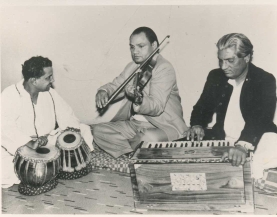
Pundit Husnalal Playing his favorite instrument violin |