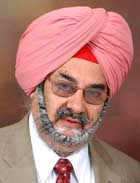
By Harjap Singh Aujla
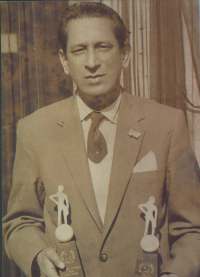 My father Late Sardar Sochet Singh was known for choosing his words very thoughtfully. About the lovers of music, he used to say “The sons and daughters born in noble (elite) families have better chance of becoming the connoisseurs of music. He meant that those who are born in highly placed and well to do families can have more exposure to the fine art of music. My father was about six years older than music director Khurshid Anwar. But during his four years of education in Lahore , he did not have the opportunity to meet Khurshid Anwar. During his graduation and MA courses, my father got acquainted to another music director Ghulam Haider and he listened extensively to the music of this great maestro.
During the turbulent days of 1947, my father visited Amritsar several times in connection with finding solutions to the problem of communal strife. On two such occasions in the evenings he used his free time to watch Saigal – Suraiya classic “Parwana”. He was so much mesmerized by the music of this cinematic master-piece that he bought its records from the famous Hall Bazaar. My father has been a great fan of K.L. Saigal, but in film “Parwana” he especially liked the Suraiya numbers too, because the tunes were soaked in emotions. My father’s favourite number was “Jab tumhi nahin apne, duniya hi begani hai. Ulfat jise kehte hain, ik jhooti kahani hai”. This sad song expressing deep emotions and pathos used to bring tears in my father’s eyes. When my father thought of the massacres of innocent people on both sides of the Radcliffe Line, he used to remember the lyrics of this song penned by D.N. Madhok and composed into a soulful tune by Khwaja Khurshid Anwar. One stanza in this “Ghazal” was written by another great poet Nakhshab, the wording is “Jaate huwe kyon tumko is dil ka khyal aataa, thukra ke chale jana ik reet purani hai”.
Since 1947, my father had become a great fan of music director Khurshid Anwar. He liked Khurshid Anwar’s music in film “Singaar” (1949) too. One day my father was listening to Radio Pakistan Lahore, he heard a unique tune of recital of “Waris Shah’s Heer” by “Ghazal singer” Ghulam Ali. My father was impressed. Then the announcer said that it was composed by music director Khurshid Anwar for film “Heer Ranjha”. My father told me that throughout the years of his life, he had never heard such a perfect rendition of “Heer Waris Shah”. He could not be more correct. Even the part sung by Noorjehan in the same film had become immortal. Since then every “Heer” singer of Pakistan , including Showqat Ali, Inayat Hussain Bhatti and the lesser known singers have started copying the magnificent Khurshid Anwar composition. This in itself is a great complement to the genius of music director Khurshid Anwar, who put his heart into this tune.
I have written about a number of music directors of the Indian Sub-continent and had a curiosity of knowing about this genius too. His son Irfan Anwar gave me some very valuable pieces of information and recordings of his music. Other than his son I had prolonged discussions about Khurshid Anwar with music directors Sardul Singh Kwatra and S. Mohinder. Surinder Kaur, the Nightingale of Punjab was all praise for Khurshid Anwar and she had growing words for this maestro.
Khurshid Anwar ancestrally belonged to a very well educated and very well placed elite family of “Bhaati Gate” (Bhaati Darwaza) area of Punjab ’s capital Lahore . Surinder Kaur also hailed from this very area. Khurshid Anwar’s maternal grand-father Khan Bahadar Dr. Sh. Atta Mohammad belonged to Gujrat district of Punjab and his eldest daughter was married to poet laureate Dr. Sir Mohammad Iqbal. At the time of Khurshid Anwar’s birth (1912), his maternal grand-father was working as the Civil Sergeon Mianwali.
Soon after his birth his mother came back to her in-laws residence in Lahore . At that time of Khurshid Anwar’s father Khwaja Ferozuddin Ahmad was a student of B.A. at Government College Allahabad. He went to England in 1913 to study law and returned in 1915 after becoming a “Barrister at Law”. During this period Khurshid Anwar remained with his paternal grand-father Khwaja Rahim Bakhash. famous bureaucrat of Lahore and his paternal grand-father Khwaja Rahim Bakhsh, who was a deputy commissioner some where in East Punjab . Born with a silver spoon in his mouth, Khwaja Khurshid Anwar was exposed to the best educational and entertainment opportunities. He did his schooling with distinction from famous Central Model School in Lahore . He got his college education from nationally acclaimed Government College Lahore. Khurshid Anwar did his master’s degree in philosophy as a topper with first division, which was a rarity during those days. As a true artist, he did not bother to attend the convocation and his crowning moment, because his Ustad in music was supposed to perform at their house.
Irfan Anwar says that his father (Khurshid Anwar) got his basic training in classical music from Lahore ’s ( India famous) classical teacher and performer “Ustad” Tawakkal Hussain Khan. Here I apologise to disagree with him. I do not deny that his basic educator was Ustad Tawaqqul Hussain Khan, but he was exposed to a lot more variety of pure classical music. During those days Punjab had a flourishing “Gharana” (school of music) known as the “Patiala Gharana”. This umbrella “Gharana” enjoyed the patronage of the royal family of Patiala . Its “Sub-Gharanas” were thriving at Sham Churasi in Hoshiarpur, village Kahma (the birth place of famous music directors Pandit Amar Nath, Husan Lal and Bhagat Ram), the city of Hoshiarpur, the Muslim populated Bastis of Jullundur, the Princely town of Kapurthala, the old towns of Sultanpur Lodhi, Kasur (Lahore district) and Multan. Music was thriving at all these places and was patronized by the elite in Lahore , Patiala and Amritsar . Amritsar was leading in the development of “Khayal” and “Thumri” style of music. India ’s leading “Thumri” exponent Indu Bala was born in Amritsar . There is no chance that a brilliant young man like Khurshid Anwar could have remained uninfluenced by this vast treasure of music.
A great vocalist of the time Vinayak Rao Patwardhan had opened a Vidyalaya of North Indian Classical Music, known as “The Patwardhan Vidyalaya” in Lahore . This academy had a profound impact on the learners of music in Lahore . I don’t think Khurshid Anwar would have stayed aloof from it. Moreover, the most famous exponent of “Dhrupad Shelley” of classical music Dalip Singh Bedi (later on known as Dalip Chander Vedi) had also moved from his place of birth Amritsar to Lahore . He had a huge influence on the musicians of Lahore . Bade Ghulam Ali Khan was the jewel amongst the musicians of Punjab . To put it precisely, Khurshid Anwar was very well groomed into classical music.
In 1935 Khurshid Anwar completed his education by topping in M.A. Philosophy from the Punjab University Lahore. Khurshid Anwar’s parents wanted to see him as a top bureaucrat of Punjab . He in fact appeared in the ICS (Indian Civil Service) examination and qualified the written with an impressive score in 1936. But some of his anti-British activities during the early college years came to light and that became his undoing. The British rulers made it sure that he does not make it during his oral examination. Khurshid Anwar was totally unperturbed by this setback. His soul and mind were in music and he wanted to pursue his hobby to the extent of an obsession. From that defining moment, Khurshid Anwar decided to wholeheartedly pursue his hobby of music. He started devoting more and more time to the teachings of his illustrious Ustad Tawakkal Hussain Khan.
All India Radio Delhi came on the air in 1936. khurshid Anwar was about twenty four year old then. He had completed his education and wanted to plunge head long into the composition of music. Patras Bukhari was a big wig at All India Radio Delhi. Khurshid Anwar knew him. Khurshid Anwar joined All India Radio Delhi in 1939. he hired Roshan (later on a famous music director of Bombay ) as a Dilruba player possibly in 1940. There was no dearth of poets in India at that time. Thus there was plenty of good poetry to make tunes. Khurshid Anwar loved his tryst in New Delhi with the art of music composition.
During those days All India Radio Delhi became the flag-staff station of India . Its talent pool was spread over the vast provinces of UP., C.P. C.I. Rajputana and Bihar . Before becoming a music composer, Khurshid Anwar tried his hand at composing poetry too. One of the two most famous Urdu poets of the century Faiz Ahmed Faiz was his contemporary. The both studied in Lahore . Both learned a lot from each other. In fact during the early years Khurshid Anwar was acclaimed to be a better composer of lyrics than the famous Faiz.
If you are a good poet and you have taken training in classical ragas, you automatically have a head start over your contemporaries. Khurshid Anwar’s stint at All India Radio Delhi gave him a much needed experience to start a new life as a film music director in Calcutta or Bombay .
Abdul Rashid Kardar had moved from Punjab to Bombay . He wanted to produce a Punjabi film. He came to Delhi (approximately in 1941) to persuade Khurshid Anwar to compose music for his maiden Punjabi film “Kurmai”. Khurshid Anwar agreed and left the government service to take a plunge into films. When the film was released and the music was heard, it came out with flying colours. “Kurmai” had a musical score, which was a number of years ahead of its competition being composed in Lahore . Rajkumari was a very well groomed singer of Hindustani film music, her first assignment as a playback singer in Punjabi was an instant success. The male singer was another Punjabi G.M. Durrani. Durrani also sang very well. The third singer was Iqbal Begum, who was also a genuine Punjabi singer. All three sang their heart out and Khurshid Anwar established himself as a brilliant music director at an alien place far away from home. During his initial years, Dina Nath Madhok composed most of the lyrics for his songs.
In fact Khurshid Anwar was a pioneer among the Punjabi music directors, who left their homes and hearths to set up shop in Bombay . After his success, a lot more of them made a beeline to Bombay . Shyam Sunder was the first to follow. After hearing Rajkumari’s voice in “Kurmai”, Shyam Sunder came all the way from Lahore to Bombay to record Punjabi film music in the voice of Rajkumari. Soon afterwards Shyam Sunder moved back to Lahore to return again to Bombay in 1943. Prominent among others who followed him were Ghulam Haider, Pandit Husan Lal Bhagat Ram, Hans Raj Behl, Feroze Nizami, Rashid Atre. Many others followed after 1947.
Bombay is a great melting pot of cultures. Music springs out of it like a fountain. Those who jump wholeheartedly into Bombay ’s cosmopolitan character, come out with totally different and much more versatile personalities. Bombay produces and nourishes a great number of brilliant instrument players. Khurshid Anwar, like scores of other music makers, benefited immensely from the services of these gifted instrument players. Bombay attracts talent from all the provinces of India and each entrant contributes a lot from the music of his region. Those who come to Bombay , their horizon of professionalism expands a lot. That is why on his return back to Lahore after 1947, Khurshid Anwar had an exclusive place nitched out for himself. Noorjehan was one who fully understood the genius of this prince amongst the music directors of the Indian Sub-continent and she rendered his compositions with utmost love, respect and devotion. Under Khwaja Khurshid Anwar’s music direction, even in a few songs, Zubaida Khanum came close to becoming Pakistan ’s answer to the doyen of Indian playback singing Lata Mangeshkar. Zubaida Khanum’s sudden retirement from music after her marriage in 1960, was one of the worst things that happened to Pakistan ’s playback singing. She had a shrill voice and typically Punjabi accent.
At the time of Khurshid Anwar’s arrival in Bombay , several other stalwarts of music direction, who flourished in Calcutta , also shifted their base to Bombay . These Bengali music directors brought their own brand of refinement to the music industry of Bombay . Timir Baran was one of them.
Bombay ’s main Hindi/Urdu cinema had a saturated field of music composition, which included stalwarts like Anil Biswas, Khem Chand Prakash, Naushad, Rafiq Ghaznavi, Gian Dutt and many others. A.R. Kardar engaged Khurshid Anwar for his next Hindi film “Sharda” (1942). For this film he composed one song written by lyricist D.N. Madhok. The words are “Ghir aayi badariya ghar aao), but when he discovered that his friend J.K. Nanda was not the director, he left the film. D.N. Madhok gave the song the Naushad for using the same tune. His next big film happened to be “Ishara”. In this film Khurshid Anwar came out with flying colours. He primarily used the female voices of Suraiya and Gauhar Sultan. Gauhar Sultan, who was not a big name, did better than Suraiya. Gauhar Sultan’s emotional rendition in song “Shabnam kyon neer bahaye” received a critical applause from both the elite and the commoners.
After “Ishara” Khurshid Anwar got orders for one film each for 1944 and 45. His lineup of films made in India is as follows:
- Kurmai (a Punjabi film made in 1941).
- Ishara (1943)
- Parakh (1944)
- Yateem (1945)
- Aaj Aur Kal (1947)
- Pagdandi (1947)
- Parwana (1947)
- Singhaar (1950)
- Nishana (1950)
- Khamosh Sipahi (1950)
- Neelampari (1952)