



Ganga Sagar: History, Legend, Devotion ...by MANPREET KAUR SINGH
The human psyche has a unique fascination for tradition and history,
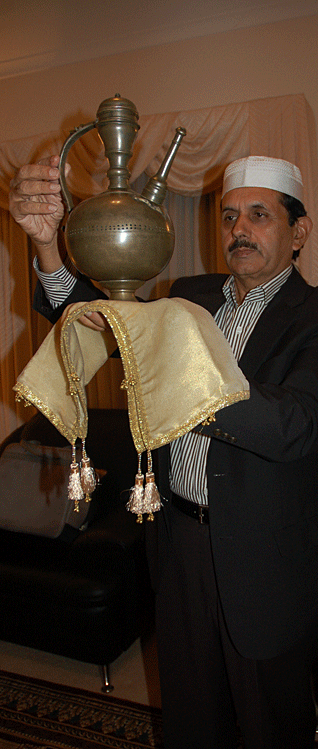
whether oral or written. But nothing is more evocative than tactile history - when a tangible object revered by tradition and talked about in history books can be seen and touched, combined with a presentation of its historical context dating back to several centuries ago. And when this tangible evidence is linked to religious history, it evokes a euphoric sentiment rarely seen anywhere else in modern-day society. So it was natural to see the strong public reaction among Punjabis across Australia, when Rai Azizullah Khan recently brought the sacred relic Ganga Sagar for darshan (public viewing) around the country. It is widely believed that the Ganga Sagar was personally gifted by Guru Gobind Singh, the Tenth Master, to the Rai family of Raikot in 1705, and there seems to be enough evidence - both empirical and anecdotal - to corroborate the same. The Ganga Sagar is an intricately crafted copper urn with symmetrical holes running around its entire circumference and at its base. Weighing about half a kilogram and standing less than a foot tall, its lid is attached to the upper body and the top has a protective mesh; it has an ornate handle and a spout. It is best described as a metallic pot. It bears a few signs of repair over the three centuries of its existence, but by and large, it is in pristine condition. How Rai Azizullah, an ex-Member of Parliament of Pakistan, a landlord from Lahore and an avid sports lover, became the custodian of an object held in awed reverence by the Sikh community, is a lesson in the essence of Punjabi history itself - it represents the fortitude of individuals who resisted moral and religious persecution, their ability to challenge authority in pursuit of righteousness and above all, it symbolises personal bonds that transcended all differences of caste, creed or religion. What makes it even more touching is the lengths that Rai Azizullah has gone to unearth the history of Ganga Sagar - he has researched public records and libraries, quite apart from historical and religious books; he has learnt the Gurmukhi script to understand the context better. With the security of the Ganga Sagar paramount, he keeps it in a
special bank vault in England. But most telling of all is his own abject reverence for the Ganga Sagar itself, his deep respect for it purely because it was once touched by Guru Gobind Singh himself. Going through records held at a Lahore library, Rai Azizullah discovered that the British had kept detailed accounts of his ancestors. The Punjab district Gazzetteer (vol. XV.A. Ludhiana District Part A) published in 1904 states: "The Rais of Raikot played such an important part in the history of this District that it will be well to give some of the details connected with the family. They belong to the Mauj got or subdivision of the Rajput tribe." The book goes on to trace Rai Azizullah's ancestry back to the 12th century, when Mokul Chand, a resident of of Bhatner (or Jaisalmer), moved to the Faridkot area and founded the village Chakar. His descendent, Tulsi Das, converted to Islam in the 14th century, and four generations after him, Rai Kalha I founded the Talwandi Rai village in district Ludhiana in 1478. Nearly two hundred years later, Rai Ahmed founded Raikot in 1648, also in district Ludhiana. Another descendent, Rai Kamaluddin II, founded Jagraon in the 17th century. His son, Rai Kalha III, had the good fortune of meeting Guru Gobind Singh and being blessed by him, in January 1705 at Raikot. He was the original recipient of the sacred urn. Since then, the Ganga Sagar has been a family heirloom, a prized possession for many generations to follow (although Ganga Sagar is not directly mentioned in the Gazetteer). The Gazetteer describes Rai Kalha III as "the ablest of
the Rais." It says: "Rai Kalha, who Another book, Chiefs and Families of Note in the Delhi, Jalandhar, Peshawar and Derajat Divisions of the Panjab, authored by Major Charles Francis Massy (printed in 1890 in Allahabad), states that at one time "the Rais ruled the whole area between Ludhiana and Amabala" and goes on to describe how internecine warfare reduced their kingdom to merely "six hundred bighas." It also states that the Chiefs of Raikot are frequently mentioned in Griffin's Rajas of the Punjab. Drawing upon these references and many others, Rai Azizullah narrated the story of Ganga Sagar at every gurdwara he visited in Sydney, Adelaide, Brisbane and Melbourne, each time with the same fervour and deference. In his words, "After the battle of Chamkaur in which Guru Sahib lost his two elder sons, Ajit Singh and Jujhar Singh, two Muslims, Ghani Khan and Nabi Khan, disguised Guru Sahib as uch da pir and brought him to Raikot. As Guru Sahib rested, a simple cattle grazer by the name of Noora Mahi passed by and Guru Sahib asked him for some water or milk. When Noora Mahi expressed his inability to bring anything since he didn't have a utensil, Guru Sahib gave him a copper urn and Noora brought milk in that. The urn had many holes in it but still retained the milk, so Noora
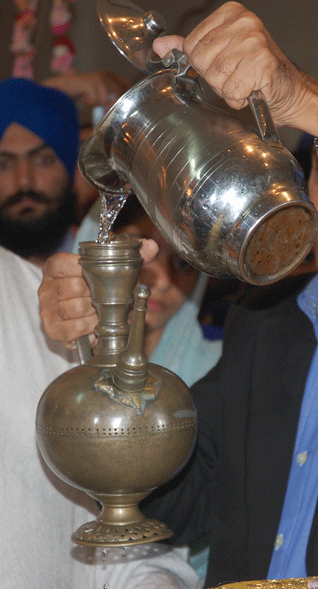
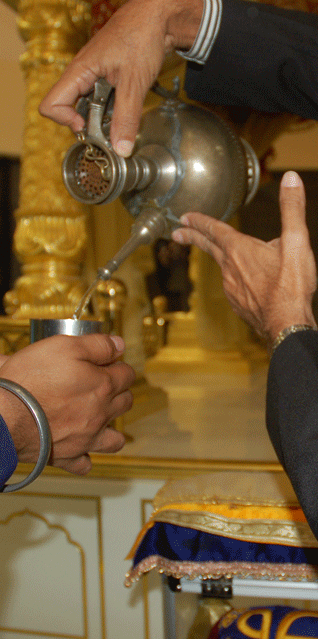
ran to tell his master, Rai Kalha He then sent Noora to Sirhind at Guru Sahib's behest, to find out what had happened to his mother Mata Gujri and his two younger sons, Zorawar Singh and Fateh Singh. In what must be called the darkest moment in India's history, Noora brought the sad news that his younger sons had been bricked alive at Sirhind and his mother had passed away, too. All this happened at Raikot." Rai Azizullah is at pains to point out, "My ancestor Rai Kalha risked not just his own life but that of his family and subjects by receiving Guru Sahib as a guest; he even risked losing his property and his entire state by incurring the wrath of Aurangzeb, the emperor. At a time when many of Guru Sahib's staunch followers failed to offer help, my ancestor Rai Kalha did what was morally right. It is in recognition of this courage and hospitality that Guru Gobind Singh presented three gifts to him - the Ganga Sagar (the same copper urn with holes in it), a sword and a rehal, a wooden stool to read holy scriptures on. All that remains today is the Ganga Sagar, since the sword was taken away by the British in the 19th century and the rehal, being wooden, couldn't withstand the vagaries of nature for so long." A gurdwara (Tahliana Sahib) was built at the place Guru Sahib rested initially at Raikot, where it still stands to date, with an inscription bearing testimony to the above story. For centuries after the holy visit, on the Gurpurab of Guru Gobind's birthday, devotees would start a Nagar Kirtan (holy procession) from Gurdwara Tahliana Sahib and go to the Rai's Haveli in Raikot, where the incumbent Rai would bring out the Ganga Sagar for all the devotees to glimpse. This tradition continued till 1947, when Rai Inayat Khan, the grandfather of Rai Azizullah, was the custodian of Ganga Sagar. After the partition of India in 1947, the Rai family moved to Lahore, and bought land in Lyallpur and Montgomery. Rai Azizullah was born in 1951, but even before he turned six, he lost his grandfather and both his parents. He was brought up single-handedly by his grandmother, but during the ensuing decades after partition, there were no public mentions or viewings of the Ganga Sagar. According to Azizullah, "with an old lady and a child as custodians of the relic, who were still finding their feet in a newly formed country, and with the animosity between India and Pakistan, other matters took greater precedence." Still, his grandmother imparted the significance of the Ganga Sagar to him over time. Says Azizullah, "My grandmother used to keep the Ganga Sagar so secretively, that in all my 24 years when she was alive, she only ever let me touch the Ganga Sagar twice! She wanted me to appreciate the magnitude of the gift that I would become custodian to and I salute her for instilling that sentiment in me." Without first-hand knowledge from his grandfather or his parents, Azizullah went on to research libraries and books for the history pertaining to Ganga Sagar and uncovered fascinating evidence. He only ever mentioned the relic for the first time in public in 1993, when he visited a gurdwara in London. Recalls Azizullah, "When the presiding granthi at the gurudwara heard me mention Ganga Sagar, he just asked me, ‘how are you related to Inayat Khan?' When I told him that he was my grandfather, the granthi hugged me and his tears flowed freely, as if he were hugging a long lost son. "Since then, I have received so much love and blessings from the Sikh community, it's been unbelievable." So, after 1947, the Ganga Sagar was displayed in public for the first time in the U.K. in the year 1994. In 1996, Rai Azizullah visited Australia. Melbourne-based Prof. Bhajan Singh Grewal, a well known Australian economist and Professorial Fellow at the Centre for Strategic Economic Studies at Victoria University, says, "My family settled in Raikot after the partition in 1947 and we used to attend the Gurpurab celebrations every year, which would run for three days, from January 2 to 4. The finale would be a very impressive jaloos (procession) around Raikot and the locals would often tell us that, before partition, Ganga Sagar was an integral part of the celebrations too." Although Bhajan Singh and his family had never seen the Ganga Sagar, they had heard nostalgic stories about it. So, when Rai Azizullah visited Melbourne in 1996 for the first time, it was a unique feeling of homecoming for the two. But the highlight for Rai Azizullah was when he visited India in 2004 on an invitation from the S.G.P.C. and hundreds of thousands of devotees gave him a euphoric welcome. "My journey from Ludhiana to Raikot took well over 11 hours, and that was a truly magical experience. I visited my old haveli in Raikot and went to the room in which my grandfather used to keep the Ganga Sagar. By coincidence, the current occupants of the house have Guru Granth Sahib ji's prakash in the same room," says Azizullah. Another stand-out memory for him is when he first set feet at Amritsar in 2004. He recalls: "As soon as we began our journey in a carriage, a Sikh ran up to me and gave me a small wrapped gift - I opened it and it was the Holy Koran," he says, with a hint of a tear in his eye. "That is what Ganga Sagar truly symbolises - the love and respect we give each other as humans, regardless of our religion or race. I truly hope that this love and respect can surpass all other artificial barriers and build strong bridges between our two countries as well." Educated in Aitchison College and Government College Lahore, Rai Azizullah is an erudite, yet humble man. A member of the PML-Q party, he served in Pakistan's Upper House of Parliament for five years, from 2002 to 2007. His occupation is listed as an agriculturist, since he has cotton and rice plantations in Lyallpur and Montgomery, though he resides in Lahore. Blessed with an affable personality and a great sense of humour, he is a committed sportsman, too. Back in the 1980s, he specially travelled to India to watch a cricket match between India and Pakistan, and then again for the Asiad in 1982. An avid golfer who is currently the Vice President of Pakistan Golf Federation, he actually came to Australia to attend the World Golf Council summit held in October, along the sidelines of World Amateur Golf Championship for Eisenhower Trophy. It's only at the request of the Australian gurdwaras, that he made a special trip to England to bring the Ganga Sagar back with him - the second time that Australian Sikhs got to see the relic. After his return from Australia, he led a Pakistan Punjab team to Chandigarh, where they challenged the Indian Punjab team at golf - a tournament designed to improve relations between the two countries. It is interesting, though, that the Ganga Sagar has over two hundred holes around its belly and at its base - one can clearly see light through these holes when one holds the Ganga Sagar up. Purportedly, if you put in sand from the top, it pours out immediately, but when you pour in liquid, such as water or milk, it remains in and doesn't pour or ooze out. Firm believers call it miraculous and sceptics attribute it to surface tension. But for Rai Azizullah, "This isn't important at all. The Ganga Sagar isn't significant because it retains fluid despite the holes ... to me and my family, if this were just a pot of clay given by the Guru, it would still have inspired the same significance and reverence." As with anything, there are detractors and critics too; some question the veracity of the story behind the Ganga Sagar and others question the authenticity of the relic itself, but Azizullah tries not to pay attention to them. He also points out to numerous references about the Ganga Sagar in Punjab's history and literature. "Bhai Kahn Singh Nabha's Encyclopaedia of Sikh Literature refers to it on pages 311, 550 and 1037; Prof. Harbans Singh's Encyclopaedia of Sikhism refers to it on page 416 of the second volume; Dr. Harjinder Singh Dilgeer's Sikh Reference Book talks about it on page 462. There are other references in Suraj Prakash, Raikot Survey Book by Bhasha Vibhag Punjab, etc.," cites Rai Azizullah. Having travelled many countries around the world, his mission is "to bring the followers of Guru Gobind Singh close to an object which was once touched by him." At the request of the sangat, he pours water into the Ganga Sagar and pours it back out through the spout in a vessel, so all present can partake of the "amrit" (holy water). In Melbourne, when someone announced at a gurdwara that "he was about to demonstrate" this to the public, Azizullah was quick to point out respectfully that "I'm not here to demonstrate or prove anything. In fact, if people are merely curious to see whether the urn retains water or not, I prefer not to show it to them, let alone pour water into the Ganga Sagar in front of them. I don't do this to satisfy people's curiosity, its just for the followers of the Guru to commune with an object that he once held in his precious hands." Since the sangat around Australian gurdwaras were a manageable size, they even had the unique opportunity to touch the relic with their own hands - something that was impossible in India because of the huge throng of devotees. Rai Azizullah is the 9th descendent of the Rai family after Rai Kalha III, the original recipient of the Ganga Sagar. Interestingly, there has only been one male descendent in the family for many generations, and he himself has four daughters and just one son, Mohammed Ali Khan, who will go on to become the next custodian of the Ganga Sagar. Azizullah says with a smile: "Although I have let him touch the sacred relic more times than my own grandmother let me, I hope to instil the same sentiment in him so this relic can continue to foster relationships and bonds for many more generations to come."
December 30, 2008
|
 appears to have been a ruler of great ability, extended his power up to
Ludhiana, which passed into his hands a few years before the capture of
Sirhind by the Sikhs in the manner described in Chapter 1.B. After
that event, he established independent power over the whole of Jagraon
(the place of the Rais) and the greater parts of Ludhiana tahsils
and also a large portion of the Ferozepore District. The family
was on at least equal terms with the Pathan rulers of Maler Kotla and
the Phulkian chiefs, with the latter of whom their relations were
friendly on the whole."
appears to have been a ruler of great ability, extended his power up to
Ludhiana, which passed into his hands a few years before the capture of
Sirhind by the Sikhs in the manner described in Chapter 1.B. After
that event, he established independent power over the whole of Jagraon
(the place of the Rais) and the greater parts of Ludhiana tahsils
and also a large portion of the Ferozepore District. The family
was on at least equal terms with the Pathan rulers of Maler Kotla and
the Phulkian chiefs, with the latter of whom their relations were
friendly on the whole." 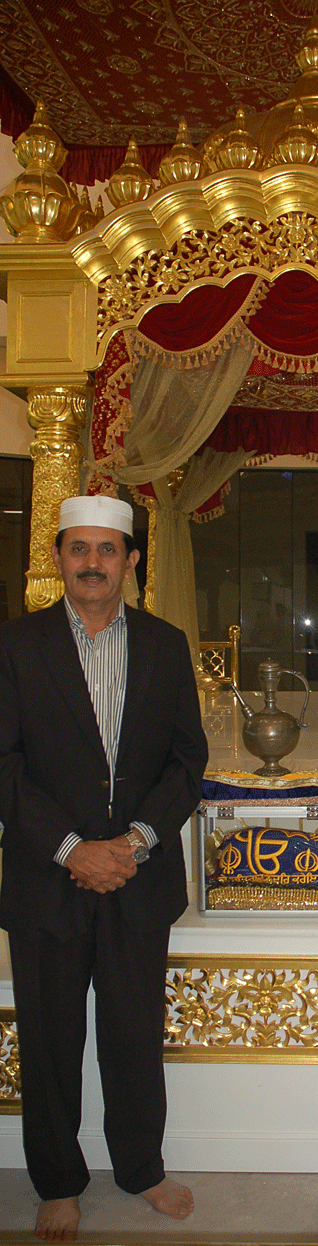 III, about the incident. When Rai Kalha came to meet Guru Sahib,
he wholeheartedly extended his hospitality to the Guru, even though he
knew that the Mughal emperor Aurangzeb would disapprove of it.
III, about the incident. When Rai Kalha came to meet Guru Sahib,
he wholeheartedly extended his hospitality to the Guru, even though he
knew that the Mughal emperor Aurangzeb would disapprove of it.